
Deformable-mirror correction of an aberrated focus
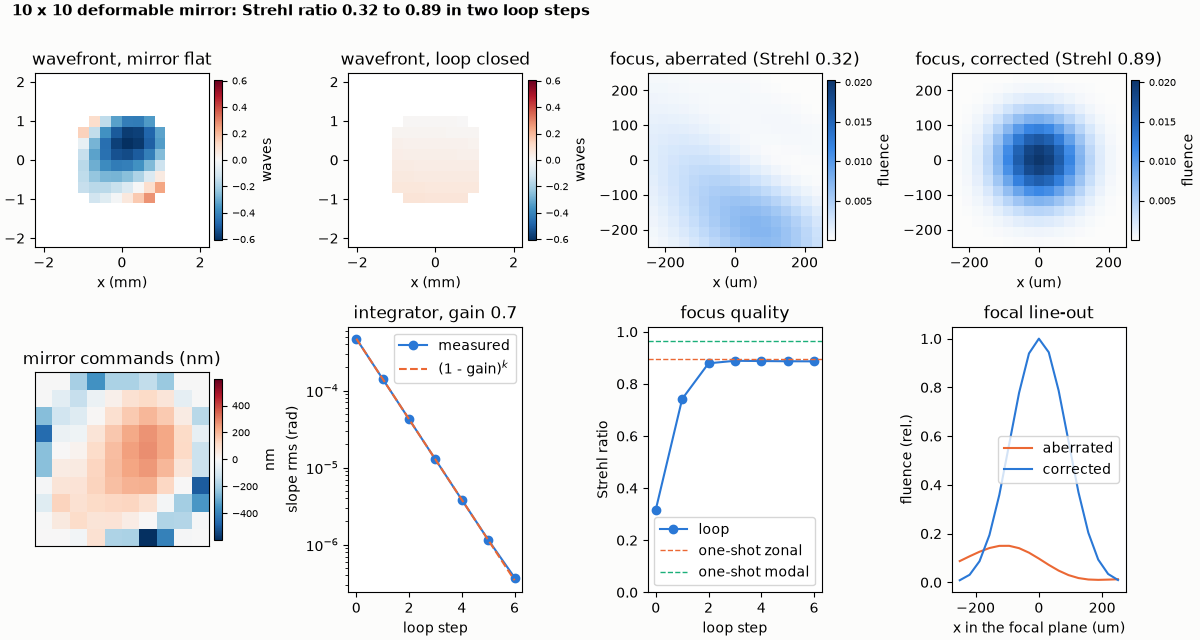
A 10 x 10 deformable mirror, calibrated and run in a closed loop, restores the focus of a beam with defocus, astigmatism and coma (Strehl 0.32 to 0.89).
The story. A laser beam picks up defocus, astigmatism and coma on its way to the experiment (0.30, 0.20 and 0.15 waves rms) and
its focus is smeared out: the focal peak is 0.32 of the diffraction limit (the Strehl ratio). A 10 x 10 actuator deformable mirror
(ao plugin), a wavefront sensor and a few lines of control restore it. The example measures the aberration, calibrates the
mirror by poking every actuator (the interaction matrix), corrects in one shot, and closes the loop with an integrator.
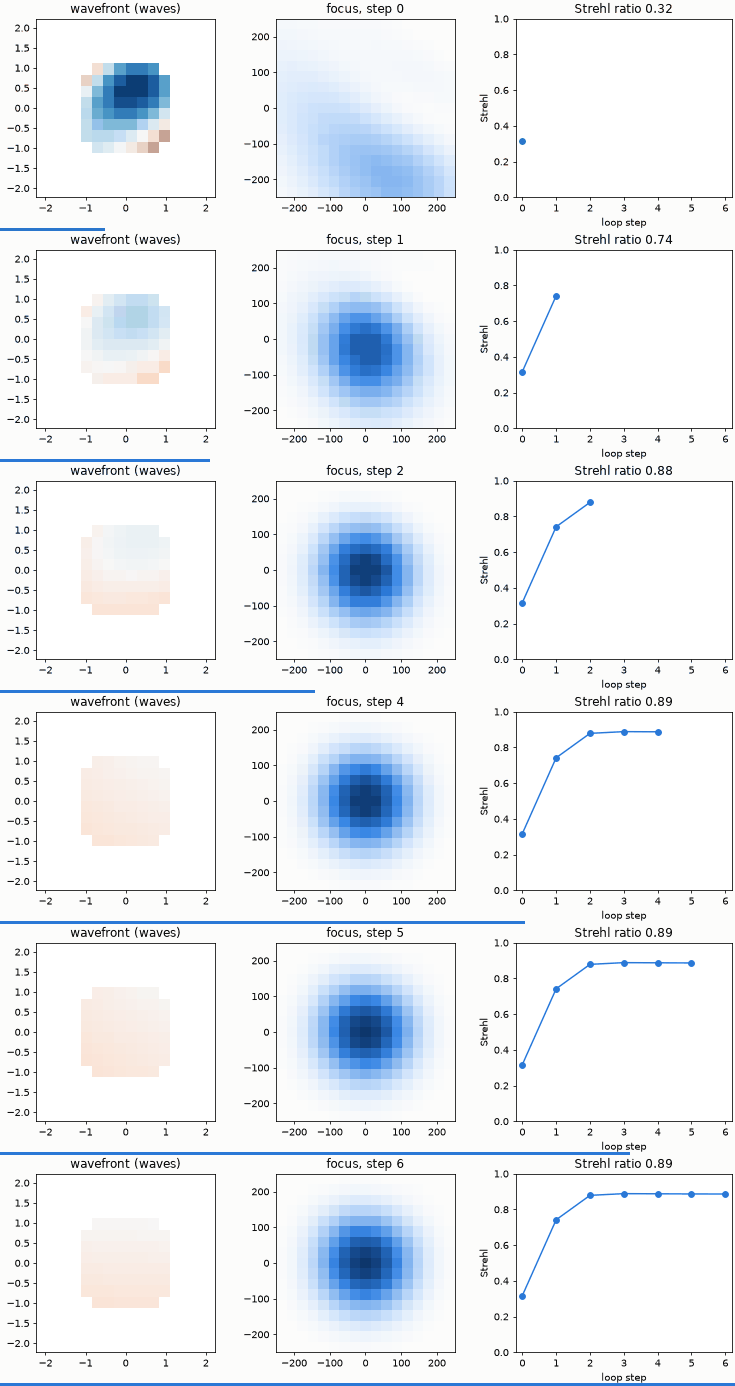
Left to right in the animation: the measured wavefront, the focus and the Strehl ratio at each loop step.
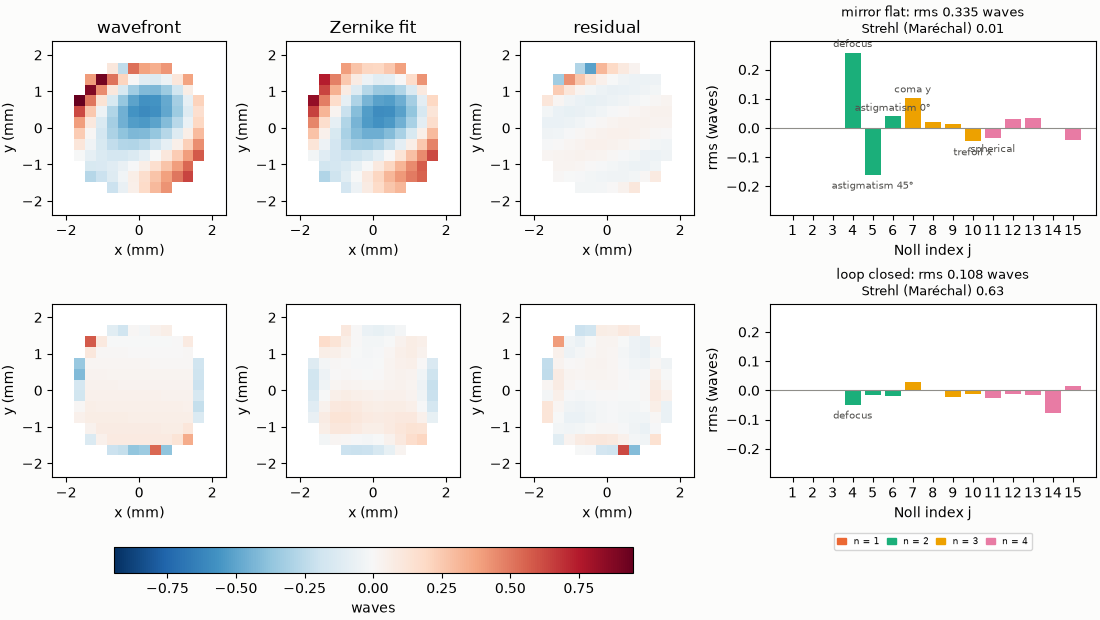
The Zernike decomposition of the same wavefront before and after (ultrafast.plotting.zernike):
Layout (dm_correction.py): Gaussian source (1 mm radius, 1030 nm) → aberration screen (a modulator) → deformableMirror
(10 x 10, 0.4 mm pitch, Gaussian influence with 15 % coupling) → [wavefrontSensor instrument, 16 lenslets] → lens (f = 0.5 m) →
camera (beamProfile). Each measurement is one engine run (about 0.1 s). ultrafast_ao.DmBench builds this bench.
python dm_correction.py
python make_figures.py          # optional: hero.png, zernike.png, animation.gif (about 10 s)
aberration (Noll index: waves rms) {4: 0.3, 5: -0.2, 7: 0.15}, DM 10 x 10 actuators of 0.4 mm
Strehl ratio: aberrated 0.32, one-shot zonal 0.90, one-shot modal 0.97
closed loop, gain 0.7: slope rms per step 4.72e-04 1.42e-04 4.25e-05 1.27e-05 3.82e-06 1.16e-06 3.73e-07
closed loop, gain 0.7: Strehl per step 0.32 0.74 0.88 0.89 0.89 0.89 0.89
slope rms falls by 0.30 per step (integrator: 1 - gain = 0.30)
checks passed
What it shows. The one-shot zonal correction (command = minus the control matrix times the slopes) takes the Strehl ratio from
0.32 to 0.90; fitting Zernike modes and commanding exactly those gives 0.97, because the mirror then does not chase the noise of
the lenslet array. The closed loop is an integrator: each step removes the fraction gain of the remaining error, so the slope rms
falls by 1 - gain = 0.30 per step (measured 0.30, the dashed line in the figure). The loop settles at 0.89, the zonal limit:
the mirror has 10 x 10 actuators and cannot make the finest part of the wavefront.
Limits. The device is idealised (no hysteresis or creep; see the plugin page). The sensor is the engine's
ideal zonal wavefrontSensor; the physical lenslet model is ultrafast.algorithms.control.shack_hartmann. Strehl is the ratio of the
focal peak fluences of the aberrated and the unaberrated beam, refined between pixels.