
Temporal pulse shaping
A spectral shaper and an AOPDF make double pulses and pulse trains, show the side pulses of pixel gaps, restore a narrowed spectrum and find an unknown chirp in a closed loop.
The story. Between a laser and an experiment sits a pulse shaper: a 4f line with a programmable mask, or an acousto-optic
programmable dispersive filter (AOPDF). Whatever you write into the spectrum is a pulse shape in time. The ao plugin has both as
elements (spectralShaper, aopdf). Here they make a double pulse, a three-pulse train and a stretched pulse; they show the
side pulses of a pixelated, gapped mask at 2π / pixel bandwidth (Weiner); they restore a spectrum that gain narrowing has
squeezed; and a closed loop finds an unknown chirp (GDD and TOD) from the peak power alone.
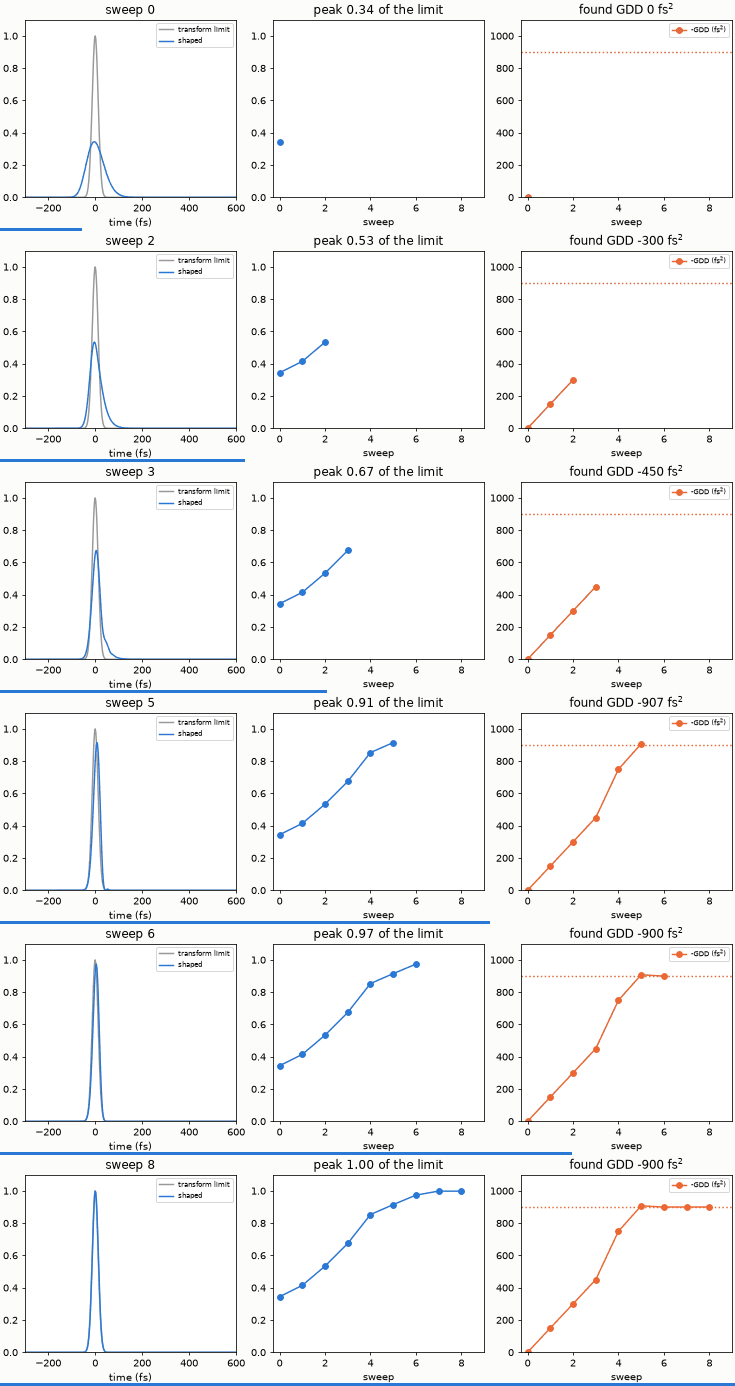
The animation: each sweep of the modal search moves the AOPDF's GDD and TOD closer to minus the chirp; the pulse returns to the transform limit.
python temporal_shaping.py
python make_figures.py          # optional: hero.png, animation.gif (a few seconds)
input pulse: 30.0 fs FWHM, 800 nm
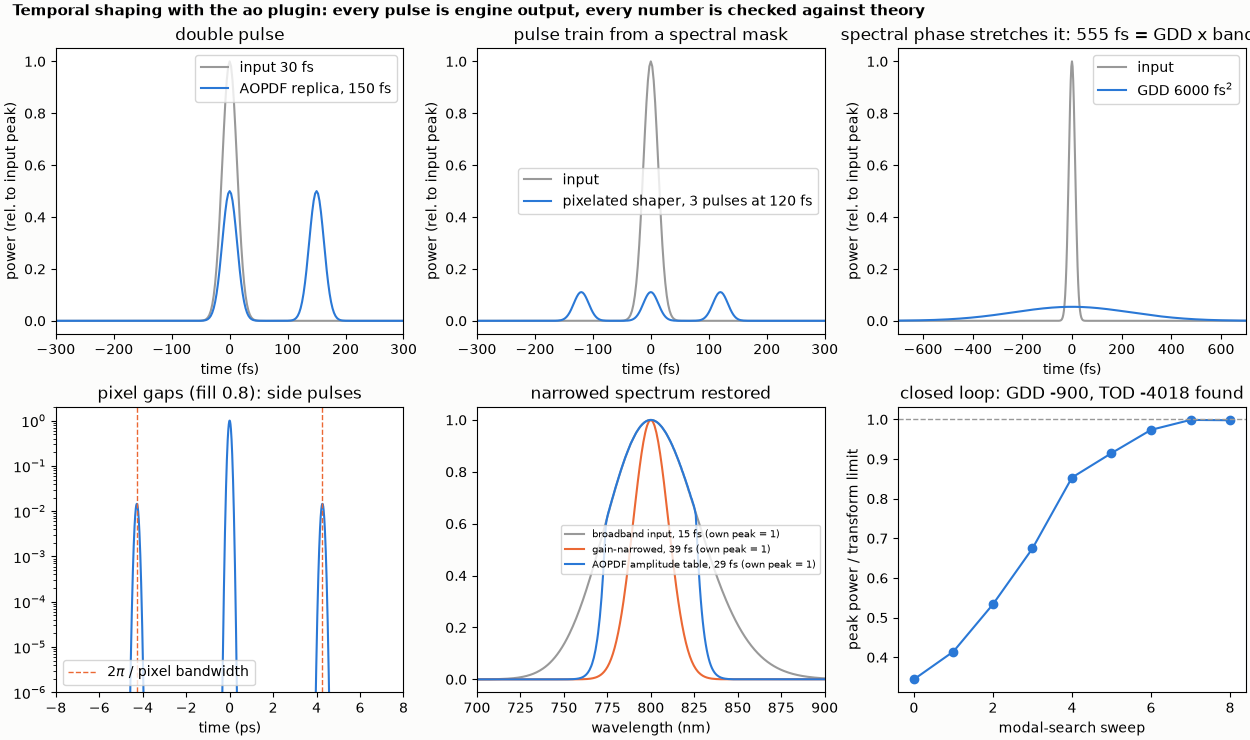
double pulse (aopdf replica, 150 fs): peaks at [-75.0, 75.0] fs, height ratio 1.000
3-pulse train (shaper, 120 fs): 3 pulses spaced 120 fs
stretched (GDD 6000 fs^2): FWHM 555 fs (stationary phase: GDD x bandwidth = 554 fs)
pixel gaps (fill factor 0.8, pixel 500 um): side pulse at 4.28 ps (2 pi / pixel bandwidth = 4.27 ps), energy ratio 0.0159 (formula 0.0159)
gain narrowing: FWHM 15.0 fs (broad input) -> 39.3 fs (narrowed) -> 29.3 fs (restored by the AOPDF amplitude table)
closed loop, unknown chirp GDD 900 fs^2 and TOD 4000 fs^3: peak power per sweep (fraction of the transform limit): 0.34 0.41 0.53 0.67 0.85 0.91 0.97 1.00 1.00
  found GDD -900 fs^2, TOD -4018 fs^3
checks passed
What it shows.
- Double pulse: an AOPDF replica (
replicaAmplitude1, delay 150 fs) gives two equal pulses 150 fs apart. - Pulse train: the shaper's mask is the transfer function
Σ_k exp(iωkτ)/3(a phase and an amplitude per pixel, 1024 pixels over 120 nm) and gives three pulses 120 fs apart. - Stretching: a GDD of 6000 fs² stretches 30 fs to 555 fs, as
GDD x bandwidthpredicts (554 fs). - Pixel gaps: a mask with fill factor 0.8 and 0.5 nm pixels leaves a side pulse at 4.28 ps (one grid step from the exact 4.27 ps) = 2π / pixel bandwidth, with the energy
ratio
[sin(πf)/(πf)]² exp(-2(π w₀/p)²)= 0.0159 (Weiner, Rev. Sci. Instrum. 71, 1929 (2000)); measured 0.0159. The run does not setgrid.windowS: the grid planner makes room for the side pulses. - Gain narrowing restored: a Gaussian amplitude filter (a stand-in for gain narrowing, not a gain model) stretches a 15 fs pulse to 39 fs; an AOPDF amplitude table that is the inverse of the filter, limited to a factor 4 so that it stays passive, brings it back to 29 fs, not 15 fs: the limit on the correction is the dynamic range, not the device.
- Closed loop: the unknown chirp is 900 fs² of GDD and 4000 fs³ of TOD; eight sweeps of modal search on the peak power find -900 fs² and -4018 fs³ (the peak power reaches 1.00 of the transform limit).
Limits. The shaper is the 1-D spectral transfer function (no spatial chirp), with a field-overlap model of the spot (the Weiner test checks the implementation, not the choice). FROG or d-scan is not wired in as the closed-loop metric; any function of a run works, here the peak power.