
23 -- Optical components and beam tracking
One beam line with the optical-component models (Optical components). No
element has a beam of its own: the run's inputBeam (w0 = 1 mm at the input) is tracked through every element.
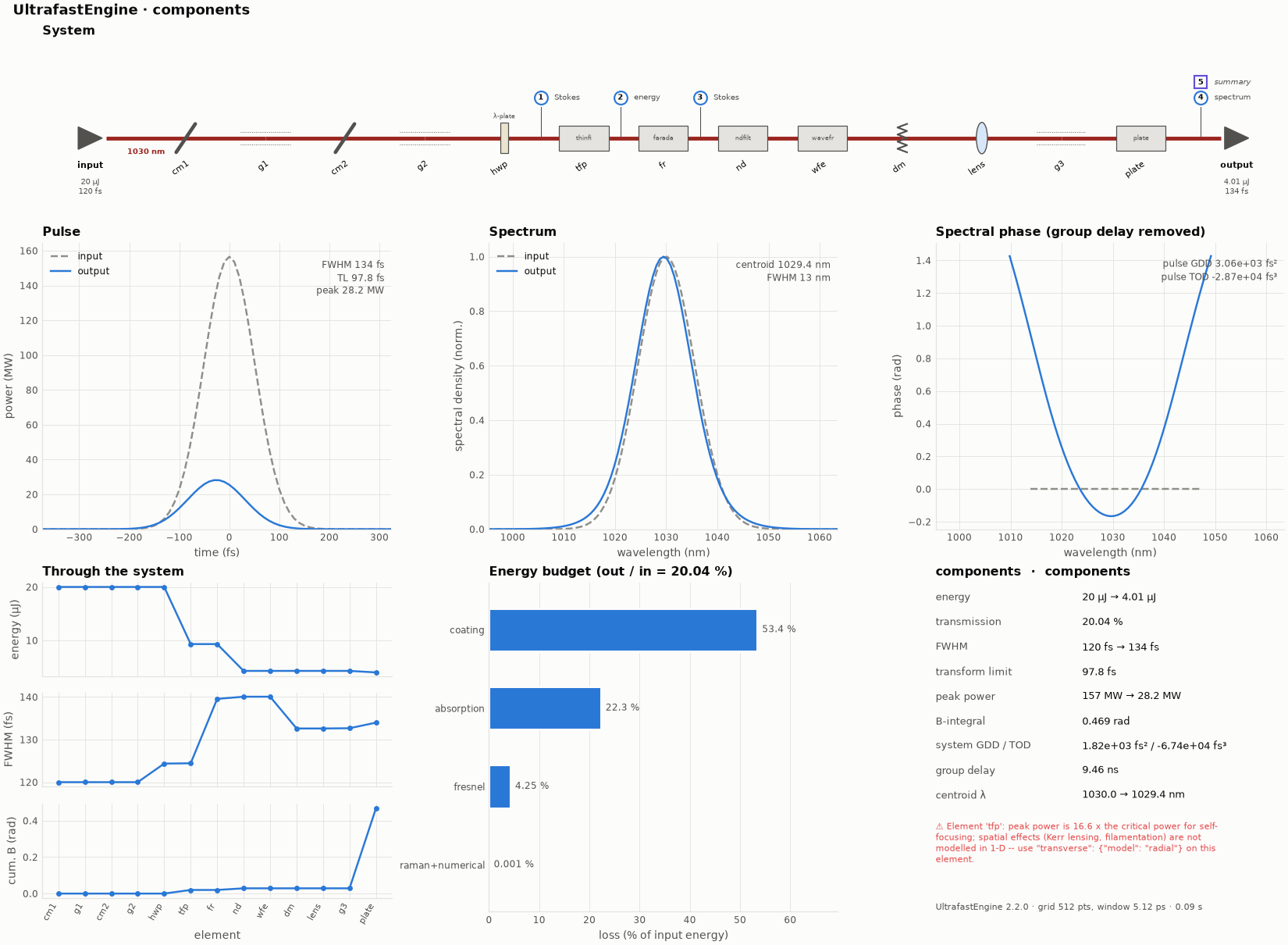
The overview figure of this example's run (python make_figures.py redraws it; the file is hero.png).
ultrafast run components.ufs run.json -o results
What to look at (results/summary.json):
elements[].values.trackedBeamRadiusXM/YM: the two R = 2 m mirrors at 8° focus x and y differently (f_t = 0.990 m, f_s = 1.010 m, see their notes), so the beam leaves the telescope slightly astigmatic (1.156 / 1.134 mm); the lens then focuses it to ~0.14 mm in the plate, whose note says it used the tracked beam.hwp: a 10th-order quartz half-wave plate -- 10.5 waves at the carrier, and 38 fs between the group delays of its axes, which depolarises a 120 fs pulse (pol_hwp: degree of polarisation 0.97, azimuth 44°).tfp: the HfO2/SiO2 stack at 56°: Tp = 0.970, Ts = 0.001 (energy_tfp: 46 % of the energy passes, because the half-wave plate turned x to 45°).fr: 45° Faraday rotation in TGG (pol_fr: azimuth 44° after the rotator).wfe: 0.1 wave rms of astigmatism over 3 mm becomes 18 nm rms over the 1.14 mm beam, Strehl ~0.988 (1-D beam: reported, not applied; give the element a cartesian transverse model to see the far field).dm: four bounces on dispersive mirrors with ±40 fs² ripple in complementary pairs: the ripple cancels.- The B-integral is almost all in the plate at the focus (0.38 of 0.40 rad).
Try: remove "inputBeam" from run.json -- tracking switches off and the plate is propagated linearly (no beam),
with a warning; or set "aoiDeg": 30 on the mirrors and watch the astigmatism grow.