
33 -- A modelled autocorrelator
The autocorrelator instrument is an ideal calculation on the field. Here is the apparatus, written with the Python API: a splitter, a delay stage, and a BBO crystal summing the two beams, with the sum-frequency energy recorded against delay. The comparison shows how far the real device can be trusted.
The crystal's second input comes from the stage arm (b.aux_beam("b", from_port=True), Branched systems). The beams are collinear here, because crossing angles are not modelled. uf.study scans the delay, 81 points per pulse, and reuses every element upstream of the stage.
cd docs/examples/Diagnostics/modelled-autocorrelator
python autocorrelator.py
100 fs     20 um   141.62    141.52    141.42
 30 fs   1000 um    42.61     42.45     42.43
 15 fs   1000 um    22.22     21.23     21.21
The columns are the pulse, the crystal, then the model, the instrument and the ideal √2 τ, in fs. The scan has steps of 0.15 τ, so the model's last figures depend on that sampling.
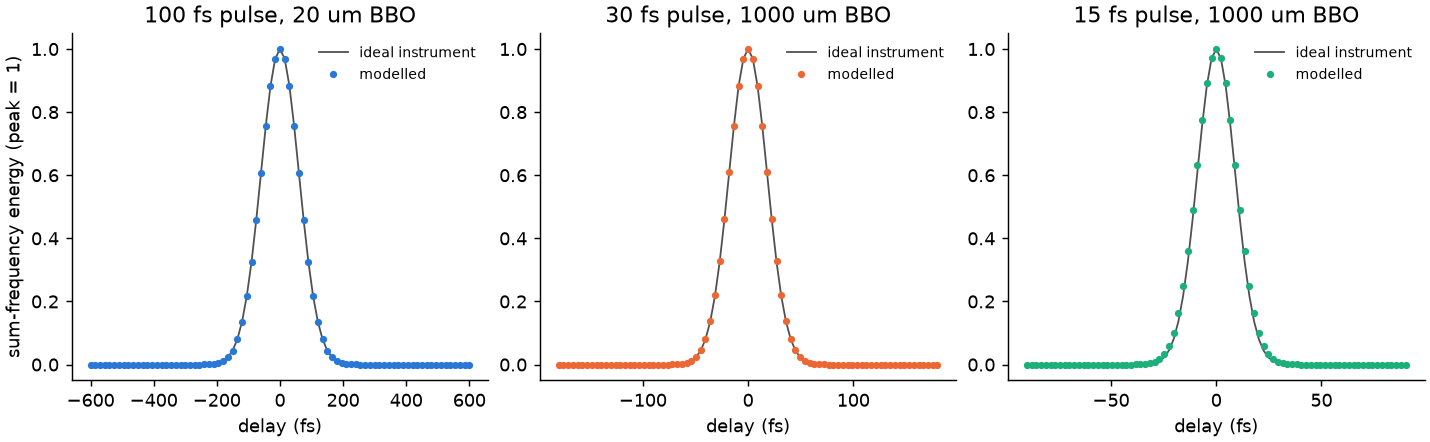
The model agrees with the instrument to 0.1 % for a thin crystal. For a 15 fs pulse in 1 mm of BBO it reads about 5 % long, which is the expected effect of the crystal's limited phase-matching bandwidth and group-velocity mismatch, left out by the ideal instrument.