
18 -- A nonlinear medium you define: n(x, y, z, t, I, F)
A 10 mm "doped glass" rod on a radial grid. The built-in Kerr effect is replaced ("replaceKerr": true) by an
expression that uses every variable a time response sees:
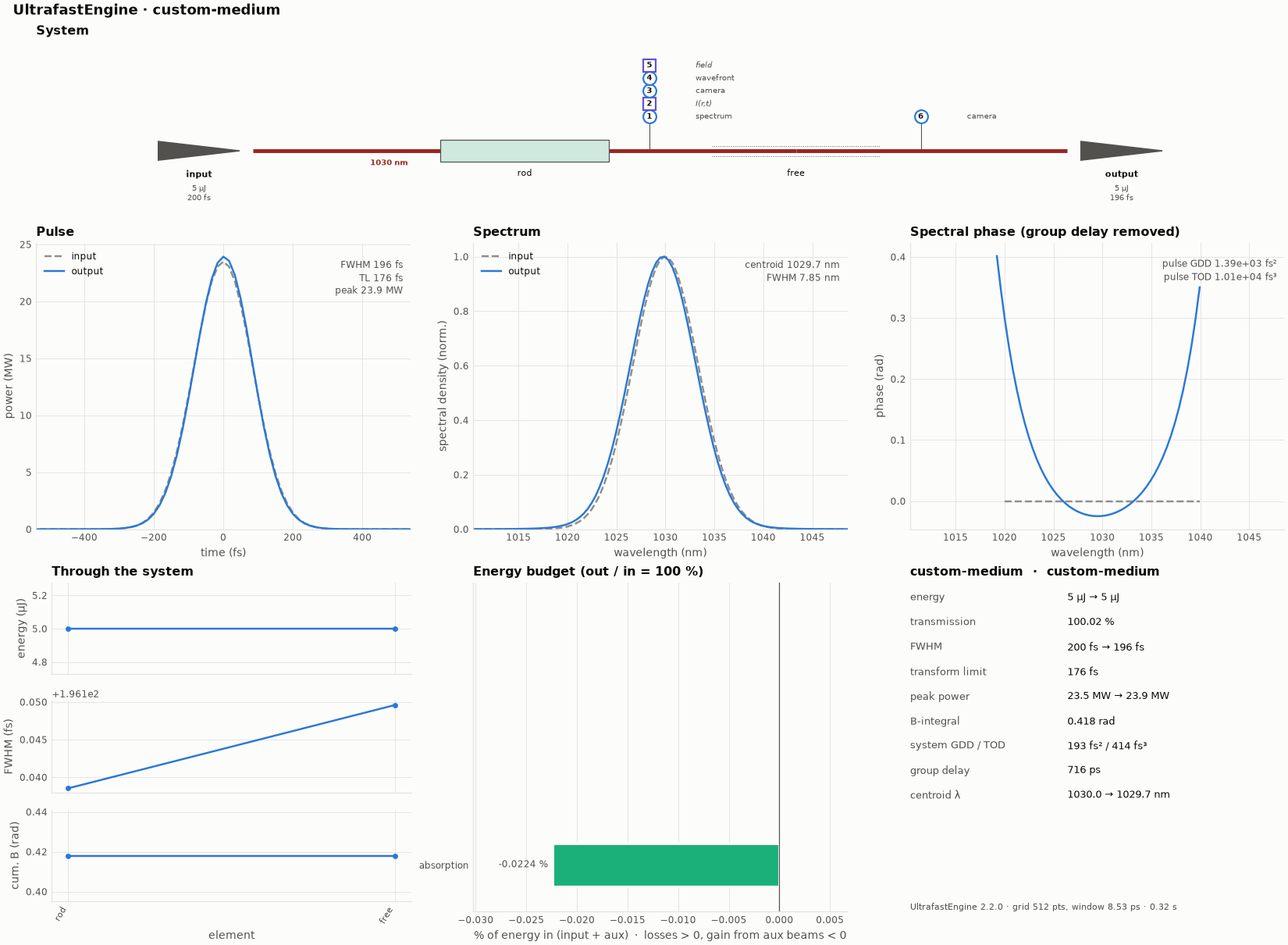
The overview figure of this example's run (python make_figures.py redraws it; the file is hero.png).
dn = n2 (1 + z/L) exp(-(r/rc)^2) I - kF F + dn_mod sin(2 pi f_mod t_lab)
| term | variables | meaning |
|---|---|---|
| n2 grows along the rod | z, L |
a doping gradient along the rod |
| only the core (r ≲ 0.4 mm) is nonlinear | r (also x, y, theta) |
a doped core in undoped glass |
| slow negative term | F = ∫I dt (running fluence) |
free carriers, a fast thermal effect |
| 1 THz modulation | t_lab |
a co-propagating driver |
On top of that the rod has a static GRIN (indexProfile) and a lossy cladding (absorptionProfile)
(docs/spatial-properties.md).
ultrafast run medium.ufs run.json -o results         # the expression in the system file
python custom_medium.py                               # the same in Python, and an x-gradient on a cartesian grid
expression (medium.ufs)              B = 0.418 rad, spectrum FWHM 7.85 nm, beam after 200 mm 351 x 351 um, centroid x = -0.0 um
Python callback, same physics        B = 0.418 rad, spectrum FWHM 7.85 nm, beam after 200 mm 351 x 351 um, centroid x = +0.0 um
cartesian grid, no Kerr effect       B = 0.000 rad, spectrum FWHM 7.81 nm, beam after 200 mm 381 x 381 um, centroid x = +0.0 um
Python: n2 (1 + x / 0.5 mm)          B = 0.368 rad, spectrum FWHM 7.83 nm, beam after 200 mm 361 x 361 um, centroid x = +3.4 um
The expression and the Python function agree exactly. A Kerr coefficient that grows across the rod tilts the
nonlinear phase front and steers the beam towards +x. A Python response is called for every grid point at
every step, with ctx.x, ctx.y, ctx.r, ctx.theta, ctx.z, ctx.t, ctx.t_lab and ctx.intensity
(docs/python.md). It is slower than an expression on large cartesian grids.