
08 -- Second-harmonic generation in LBO (the pump line for example 09)
A 1 ps, 400 uJ Yb pulse at 1030 nm is frequency doubled in 2 mm of LBO (type I, XY plane). The crystal element
follows one main beam: it enters as the 1030 nm fundamental and leaves as the 515 nm second harmonic
("output": "sh"). The unconverted fundamental is not lost: "record": ["fundamental"] keeps it as a by-product.
ultrafast run shg.ufs run.json -o results            # 1-D coupled waves, Gaussian-mode overlap (fast)
ultrafast run shg.ufs run-radial.json -o results-radial   # radial (Hankel) model across the beam
ultrafast-plot results
What to look at in results/summary.json:
elements[0].values--phiDeg(the cut found by"cut": "auto": 13.8 deg),deffPmPerV(0.82 pm/V),conversionEfficiency(~52 %),energy_sh_J,energy_fundamental_J.elements[0].carrierWavelengthMand the note "carrier changed 1029.97 -> 514.95 nm": from here on the main beam is the SH, on its own (re-planned) grid.outputGriddescribes it.energyBudget-- "to fundamental" is the energy carried off by the by-product; "numerical" is the solver's bookkeeping error (~1e-8 of the input).instruments:conversion_shg(energies and photon numbers of every field),phaseMatchingCurve_shg(angular acceptance, ~0.9 deg FWHM for 2 mm),acceptance_wavelength(spectral acceptance, ~15.3 nm).results/result.npz->probe_shg_fundamental_*: the depleted fundamental (time and spectrum).
The radial run computes the conversion point by point across the beam: the centre converts more than the wings,
so the SH beam is narrower than a Gaussian-overlap estimate suggests, and the fundamental gets a depleted
centre. results-radial/summary.json -> elements[0].beam (radius, M^2) and the beamProfile_shg instrument
(fluence vs radius) show this. The 1-D model uses an overlap of Gaussian modes, which is exact at low
conversion and an estimate at high conversion (here 52 % vs 47 % radial).
Result
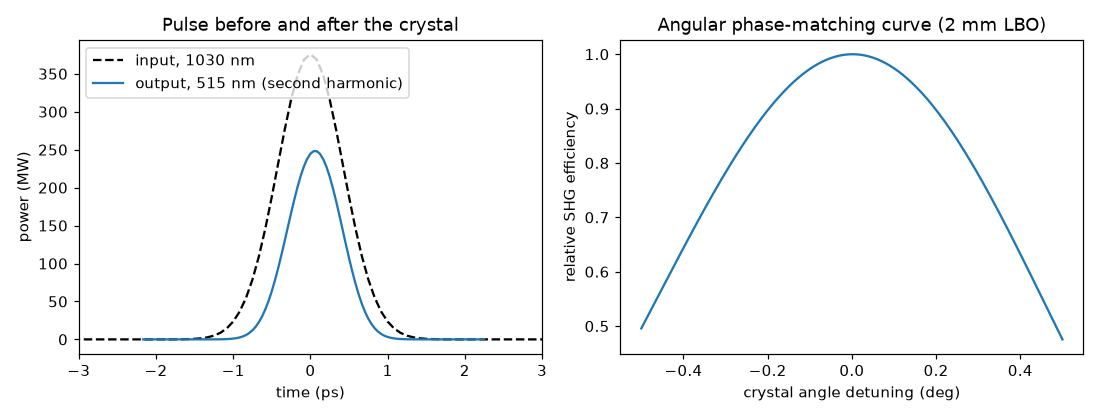
python plot.py draws this figure from results/. The 1000 fs, 400 uJ pump at 1030 nm is converted with an
energy efficiency of 52.5 % (210.1 uJ of 515 nm light, 190 uJ of fundamental left over). The second-harmonic pulse
(left, solid) is shorter than the input, 808.5 fs, because the intense centre of the pulse converts better than its
wings. The right panel is the efficiency of the same crystal as it is tilted away from the phase-matching angle:
it falls to half of its maximum at +-0.49 deg, which is the 0.985 deg FWHM angular acceptance reported by
phaseMatchingCurve_shg. This tells you how accurately the crystal has to be aligned.
Things to try:
"cut": {"thetaDeg": 90, "phiDeg": 13.8}with"detuneDeg": 0.3-- detune the crystal and watch the efficiency.- Change
"crystal"to"BBO"(type I,"cut": "auto"gives 23.4 deg) or"BiBO". "overlap": "planeWave"-- the textbook plane-wave estimate at the peak intensity (overestimates for Gaussian beams).