
06 -- Carrier-resolved propagation (index varying on the optical-cycle scale)
The time response in fast-index.ufs is written in lab time (t_lab) and oscillates at 60 THz. Because it
declares "carrierResolved": true, the engine propagates this element with the real optical field e(t)
(summary.json -> elements[0].solver.representation says "carrier-resolved field") instead of the envelope:
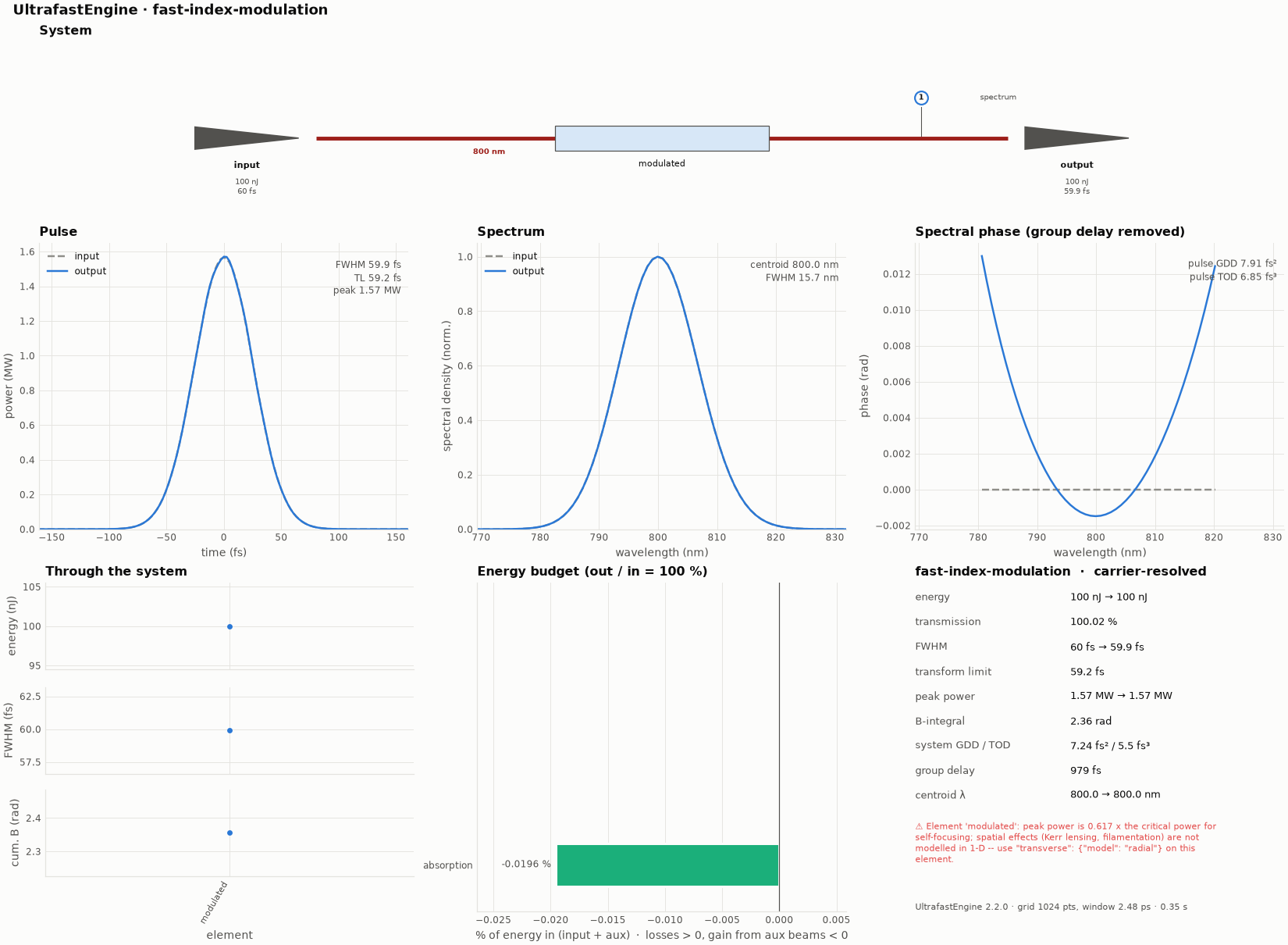
The overview figure of this example's run (python make_figures.py redraws it; the file is hero.png).
- the nonlinear polarisation is computed from e(t) itself (third-harmonic generation and self-steepening come
out automatically; energy generated outside the envelope band is reported as
harmonics (out of band)); - the modulation creates spectral sidebands at +-60 THz around the carrier (visible in the spectrometer, dB).
fieldHarmonic sets how far the real-field grid extends (3 = up to the third harmonic); grid.minSpanFraction
widens the envelope grid so the sidebands stay in band when the result is mapped back.
Use "fieldMode": "carrier" to force the real-field model everywhere, "envelope" to forbid it.