
03 -- Argon multipass cell (Herriott MPC)
A 20-pass, 0.55 m Herriott cell filled with 2 bar argon, dispersive mirrors (-30 fs^2/bounce) and fused-silica
windows. The system file is generated by make_mpc.py with the Python builders (ultrafast.build), which is a
good template for parameter scans.
python make_mpc.py                       # (re)generates mpc.ufs
ultrafast run mpc.ufs run.json -o results
Things to look at in results/summary.json:
- per-pass
bIntegralRad(~0.45 rad each) andcumulativeBIntegralRad,criticalPowerRatio(~0.1), - the spectral broadening pass by pass (
probes->probe_passNN_*arrays inresult.npz), ideal_compressor(how short the pulse could be: ~33 fs from 220 fs) andgdd_scan, a d-scan trace versus added GDD (what scanning a chirped-mirror/prism compressor would show),lidtMarginon every mirror (fluence vs the coating's scaled damage threshold),lossBudget: mirror reflectance (coating) vs window AR (coating) vs gas (none).
The Gaussian beam of each pass ("kind": "gaussian", waist mid-pass) is what the Zemax binding would export
from GBPS/GBPW for a real cell (example 07).
Result
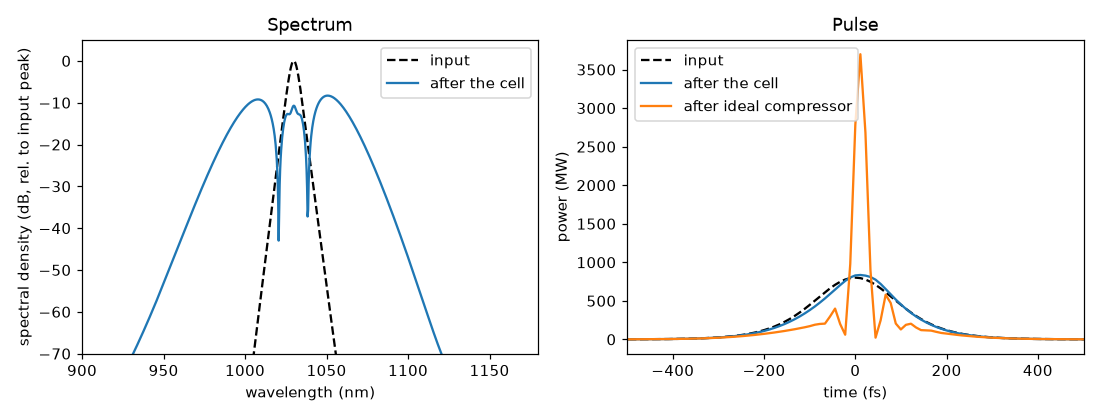
python plot.py draws this figure from results/. Over the 20 passes the pulse collects a total B-integral of
9.12 rad. Self-phase modulation turns the narrow 220 fs input spectrum (dashed) into a broad two-lobed spectrum
with a FWHM of 61.9 nm and a dip at the centre, which is the signature of a large nonlinear phase. The pulse itself
stays 197.6 fs long, because the argon dispersion and the mirrors' -30 fs^2 per bounce hardly change its shape.
The ideal compressor shows what the new bandwidth is worth: 33.1 fs and 3.70 GW of peak power, against 0.8 GW at
the input. The compressed pulse has pedestals (temporal Strehl ratio 0.76) because the SPM chirp is not perfectly
quadratic, so a pure GDD compressor cannot remove all of it.