
29 -- Small-scale self-focusing in a 2-D plate (P / P_cr ≈ 100)
A 300 fs, 130 µJ pulse crosses 10 mm of fused silica in a flat-top beam of radius 0.3 mm: 3.3·10⁸ W, about 100 times the critical power for self-focusing. A 1 % random amplitude noise with a 40 µm correlation length seeds the break-up. The beam is propagated in 2-D (x, y) on a 128 x 128 grid over 4 beam radii (Small-scale self-focusing).
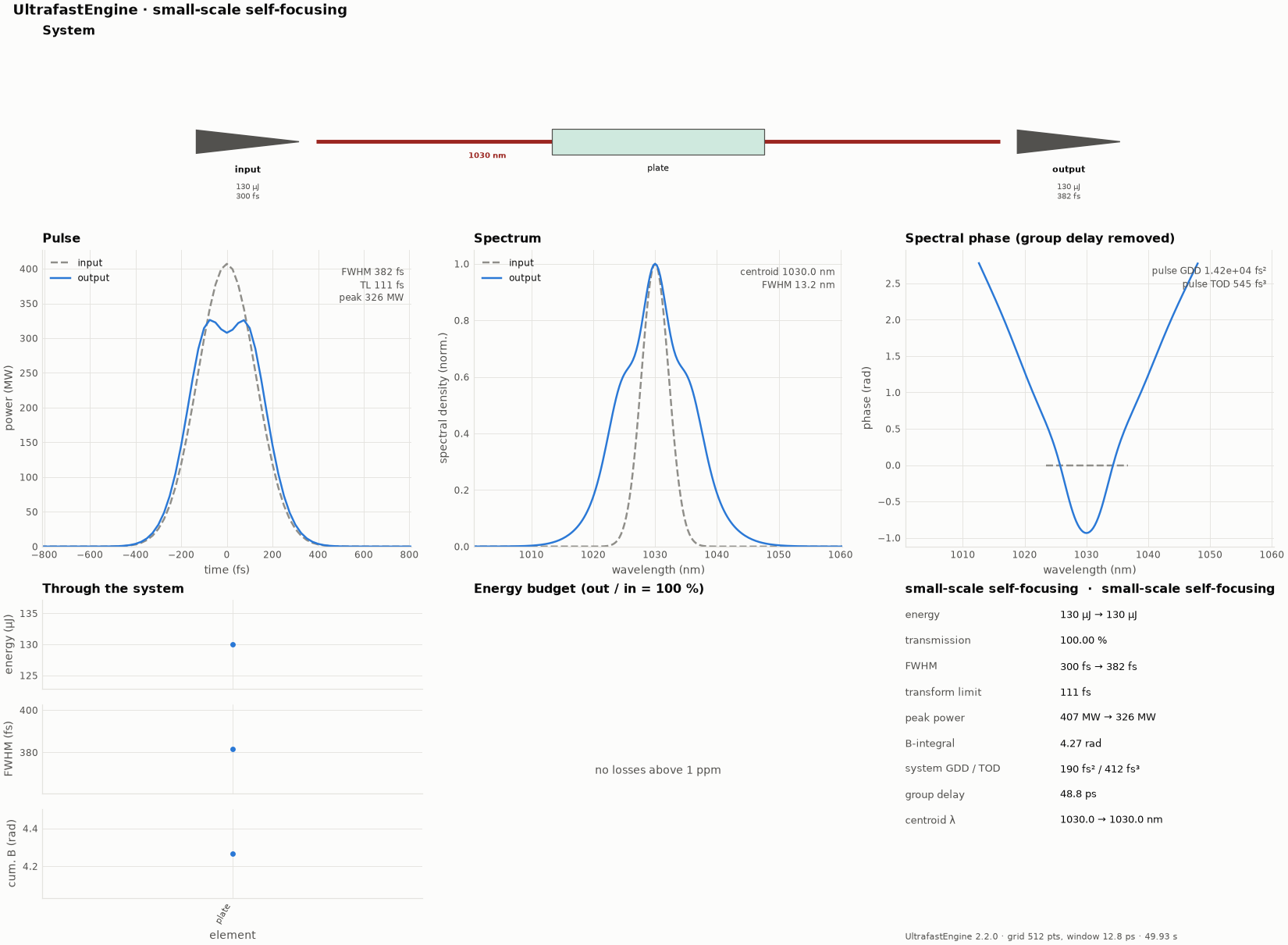
The overview figure of this example's run (python make_figures.py redraws it; the file is hero.png).
cd docs/examples/Nonlinear/small-scale-self-focusing
ultrafast run plate.ufs run.json -o results            # about 1 minute on a laptop CPU
"transverse": { "model": "cartesian", "nx": 128, "ny": 128, "halfWidthM": 0.6e-3,
  "initialProfile": { "kind": "flatTop", "noise": { "relativeAmplitudeRms": 0.01, "correlationLengthM": 40e-6, "seed": 1 } } }
Expected output (a fresh run, Apple-silicon laptop, 57 s):
  Grid auto-sized: N = 512, window = 12.81 ps, dt = 25.02 fs.
  energy 0.00013 J (T = 100.00 %), FWHM 381.6 fs (TL 111 fs), peak 3.263E+08 W, B = 4.27 rad
summary.json -> elements[0].values (the small-scale diagnostics):
| key | value | meaning |
|---|---|---|
peakPowerOverCritical |
96.5 | peak power / P_cr, P_cr = 3.77 lambda^2 / (8 pi n0 n2) |
fluenceContrastIn |
0.0148 | rms / mean of the fluence over the beam core (about twice the 1 % amplitude noise; the core holds only a few correlation cells) |
fluenceContrastOut |
0.0465 | the same after the plate |
smallScaleGain |
3.13 | their ratio: the noise has grown 3.1 x in 10 mm (B = 4.3 rad) and is not yet saturated |
The arrays el_plate_x_m, el_plate_fluence_in_x and el_plate_fluence_out_x in results/result.npz hold the fluence along y = 0.
Things to try
- The textbook seed. Replace
noiseby"ripple": {"periodM": 86e-6, "relativeAmplitude": 0.01}: one ripple at the most unstable period2 pi / sqrt(2 k Delta)(Delta = k0 n2 I) grows ascosh(Delta L)-- the Bespalov-Talanov test checks this growth law to 6 %. - Resolution. The grid must resolve the most unstable ripple (86 µm here; 128 points over 1.2 mm give 9.4 µm steps, 9 samples per period) and the
correlation length of the seed. Run 64 x 64 and 256 x 256 for your beam and check that
smallScaleGainhas converged; 256 x 256 needs 4 x the memory and about 4 x the time of 128 x 128 (not run here). - Longer pulses and the GPU.
"compute": {"backend": "auto"}runs the 2-D steps on a CUDA / OpenCL device (GPU plugin); the time window of 12.8 ps (N = 512) is what the pulse needs, not 2^13 points. - More plates. Chain several
bulkelements: the profile travels with the beam (Transverse).