
15 -- Spatially resolved gain and the thermal lens
A 2 ps, 100 µJ pulse at 10 kHz crosses a 4 mm Yb:YAG rod once, end-pumped by 60 W at 940 nm (super-Gaussian, 0.6 mm, double pass). The rod is modelled on a radial grid, and then the beam travels 0.4 m in free space.
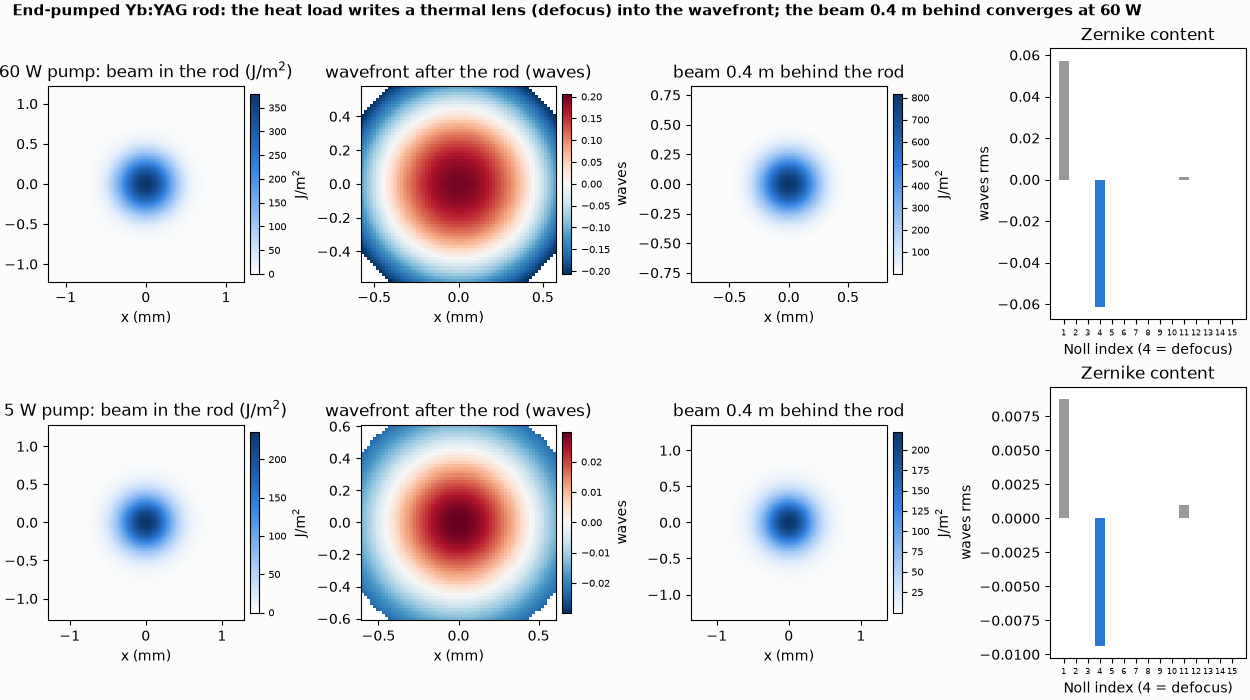
Top row 60 W pump, bottom row 5 W. Left to right: the beam in the rod (the input is a collimated Gaussian), the wavefront it leaves with (a parabola: the thermal lens), the beam 0.4 m behind the rod, and the Zernike content of the wavefront (the blue bar is defocus, Noll 4). At 60 W the lens converges the beam, so the peak fluence 0.4 m behind the rod is higher than in it (colour bars); at 5 W the lens is 10 times weaker. python make_figures.py runs the commands below and redraws it.
ultrafast run rod.ufs run.json -o results-60W
ultrafast run rod.ufs run-lowpump.json -o results-5W     # same system, 5 W pump (a run-spec override)
ultrafast-plot results-60W
On the grid:
- every transverse point has its own inversion, so the gain and depletion follow the pump and beam profiles;
- the beam diffracts inside the rod;
- the heat load (quantum defect × absorbed pump) gives ΔT(r, z) and Δn = dn/dT·ΔT, applied as a position-dependent index (docs/spatial-properties.md).
| 60 W pump | 5 W pump | |
|---|---|---|
| absorbed pump / heat | 44.3 W / 3.87 W | 4.05 W / 0.35 W |
| on-axis inversion | 0.20 | 0.02 |
| energy gain | 1.42 | 0.92 (reabsorption: Yb:YAG is quasi-three-level) |
| thermal lens f_th | 0.54 m | 5.9 m |
| wavefront after the rod (R) | −0.51 m (converging) | −3.7 m |
| beam radius after the rod / after 0.4 m | 471 µm / 319 µm | 497 µm / 524 µm |
| M² | 1.034 (aberrated lens: the pump is not Gaussian) | 1.002 |
gain.png shows the inversion across the beam (flat inside the pump, zero outside). The pulse train converges
in ≈ 70 pulses (τ = 0.95 ms ≫ 100 µs period). The far-field camera's Strehl ratio (0.41 at 60 W) is computed
against a flat-phase beam, so it includes the defocus of the thermal lens as well as its aberration.