
Kane & Trebino 1993 -- frequency-resolved optical gating (FROG)
Was the paper readable? Text yes, figures no. The whole PDF's text layer (9 pages, including appendices A-C) was extracted with pypdf (the PDF page renderer was not available in this environment), so every sentence, equation description and appendix was read. The figures were not viewed: no number below is read off a graph; what the figures show (Figs. 5-11) is UNVERIFIED here. The fit coefficients of Eqs. (5)-(7) were taken from the text layer and may carry OCR errors.
Paper: D. J. Kane and R. Trebino, IEEE J. Quantum Electron. 29, 571 (1993), doi 10.1109/3.199311 (not open access).
What FROG is (for a reader who has not seen the paper)
You split a pulse in two, cross the copies in an instantaneous nonlinear medium, and record the spectrum of the generated signal for each delay tau between the copies. The result is a picture of intensity versus (delay, frequency), like a musical score of the pulse. The paper's gate is self-diffraction (SD): the signal is E_sig(t, tau) = E(t)^2 E*(t - tau). Because the gate is the pulse itself, a 2-D phase-retrieval argument (no Fundamental Theorem of Algebra in 2-D) makes the pulse recoverable from the trace up to trivial ambiguities. Two results used here: the trace of a chirped pulse tilts (frequency rises with delay) and Appendix C turns the tilt into the chirp rate; SHG-FROG, in contrast, is symmetric in delay and cannot tell the direction of time (Appendix B).
Lab setup and what we reproduce
| item | paper (location) | our model |
|---|---|---|
| pulse | ~200 fs, positively chirped, compressible to ~100 fs, ~620 nm (p. 574) | Gaussian, 100 fs transform limit, GDD 6247 fs^2 -> 200 fs, 620 nm (engine input) |
| medium | 3 mm BK-7, 6 uJ per beam, 25 GW/cm^2 (p. 574) | engine bulk N-BK7, constant area chosen for 25 GW/cm^2 |
| FROG geometry | self-diffraction; PG discussed in App. C | engine frog instrument, types sd, pg, shg (numpy SD / PG traces as cross-check) |
| fitted pulse | Eqs. (5)-(7), tau_ref = 76 fs (p. 574-575) | built from the printed coefficients, fed to the engine as spectrum + phase |
Run: python run.py --tier fast (about 9 s) or --tier full (more retrieval seeds); --figures writes figures/;
python3 build/paper_check.py kane checks. The engine supplies the pulses, the Kerr step, its own SD / PG / SHG FROG
traces (frog types sd, pg, shg) and the PCGPA and ePIE retrieval with kinds sd-frog, pg-frog, shg-frog.
The numpy SD / PG traces in run.py are kept only as an independent cross-check of the engine instrument (the centroid
curves agree to 0.7 % of the maximum; the slopes of both are 4/3 to 1e-13).
Comparison, paper vs ours
Where the "paper" column is a law from an appendix, the reference is that law; where it is a measured number it is quoted with its location. "Ours" is from the full tier.
| quantity | paper | ours | verdict |
|---|---|---|---|
| chirp lengthens the pulse by | factor ~2 (p. 575) | 2.000 (100 fs -> 200.07 fs, by construction) | consistent |
| SD trace: mean frequency slope / chirp rate | 4/3 (App. C: w = 3/4 a t) | 1.33333 (engine frog sd: 1.33333; numpy cross-check 1.33333) |
agrees |
| PG trace: slope / chirp rate | 2/3 (App. C: w = 3/2 a t) | 0.66667 (numpy); 0.66667 (engine frog pg) |
agrees |
| SHG-FROG trace symmetric in delay | yes (Eq. B2) | asymmetry 0 (numpy), 3e-16 (engine) | agrees |
| SHG-FROG trace of a pulse and of its time-reversed twin (GDD +/-6247 fs^2) | identical (App. B) | engine frog shg: max difference 1e-15; the PG traces differ by 0.45 of the peak |
agrees |
| SHG-FROG retrieval: direction of time | ambiguous (App. B) | PCGPA on the engine's SHG trace returns GDD = +6247 and -6247 fs^2 for different seeds (12 seeds) | agrees |
| PG-FROG retrieval | no such ambiguity | GDD = +6240 fs^2 (true +6247), G = 6e-5 | agrees |
SD-FROG retrieval (engine, kind sd-frog) |
no ambiguity (SD FROG, the paper's gate) | PCGPA: GDD +6152 fs^2 (default seed; 6238-6245 for the other five), FWHM 199.3 fs, G = 1.1e-3; ePIE: +6302 fs^2, 200.3 fs, G = 1.3e-3; all 6 seeds of both give the positive sign (GDD from a fit over the part of the spectrum above 5 % of the peak, the same threshold as the engine's own test GddOf; with no threshold the ePIE phase in the spectral wings gives GDD from 2600 to 5500 fs^2, an artefact of the fit) |
agrees |
the same SD trace retrieved with the wrong kind (pg-frog) |
(not in the paper) | G = 1.2e-2, ten times the SD fit | the kind matters |
| integral of the SD trace over frequency = third-order autocorrelation (p. 575) | identity | difference < 1e-15 (numpy); engine SD delay marginal FWHM 245.2 fs vs sqrt(3/2) x 200 fs = 244.9 | agrees |
| third-order autocorrelation FWHM of the 200 fs pulse | not given (Fig. 9, UNVERIFIED) | 245.0 fs = sqrt(3/2) x 200 fs (analytic 244.95); engine PG marginal 245.2 fs | analytic check |
| 3 mm BK-7, 25 GW/cm^2: B integral | "negligible spectral broadening" (p. 574, no number) | B = 0.255 rad (2 pi/lambda n2 I L with the paper's 25 GW/cm^2 and the library n2 = 3.4e-20 m^2/W gives 0.258; the engine is 1.3 % lower because the chirped pulse disperses in the window); spectral rms width +8 %, FWHM +13 % (engine and a numpy Kerr step agree to 3e-7) | see below |
| 3 mm BK-7: GDD at 620 nm | "negligible" (p. 574, no number) | 196 fs^2 (3 % FWHM change) | consistent |
| fitted pulse (Eqs. 5-7): FWHM | "about 200 fs" (p. 575) | 204.3 fs (engine from spectrum + phase: 205.2 fs) | agrees (coefficients UNVERIFIED) |
| fitted pulse: chirp-to-transform-limit | ~2 (p. 575) | 2.07 | agrees |
| fitted pulse: spectrum with vs without the phase | "significantly narrower" without (Fig. 10 text) | rms width ratio 1.94 | consistent (qualitative) |
| fitted pulse: sign of chirp | positive (p. 575) | engine GDD +8074 fs^2 | agrees |
| fit rms 1.9 %, 33 x 33 array, Fig. 5 / 6 / 7 / 9 / 10 / 11 shapes | measured data | not reproduced: the measured trace is not available in the text | UNVERIFIED |
Plots
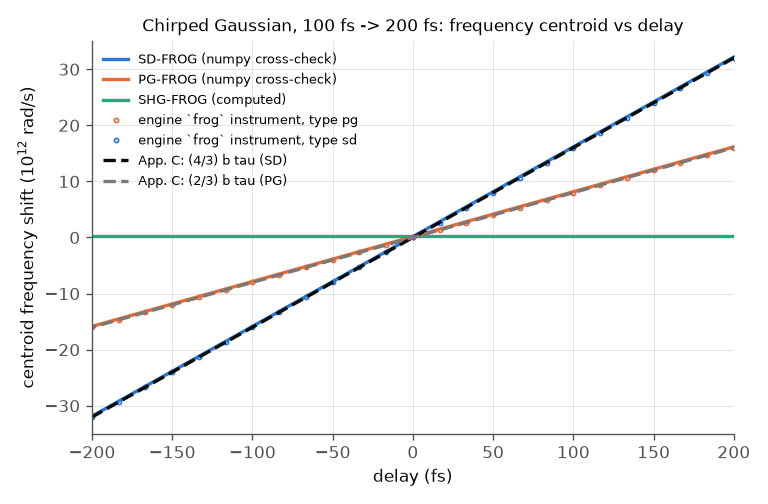
Mean signal frequency (relative to the carrier) against delay for the 200 fs chirped pulse. Solid lines: numpy cross-check, SD (blue), PG
(orange), SHG (green, flat); circles: the engine frog instrument, types sd (blue) and pg (orange). Dashed black / grey: Appendix C's slopes
(4/3) b tau and (2/3) b tau with b the chirp rate of the pulse (analytic 1.2e26 rad/s^2, equal to the field's to 1e-13).
The SD trace amplifies the chirp by 2 relative to the PG trace, the paper's "self-diffraction FROG is more sensitive
to chirp".
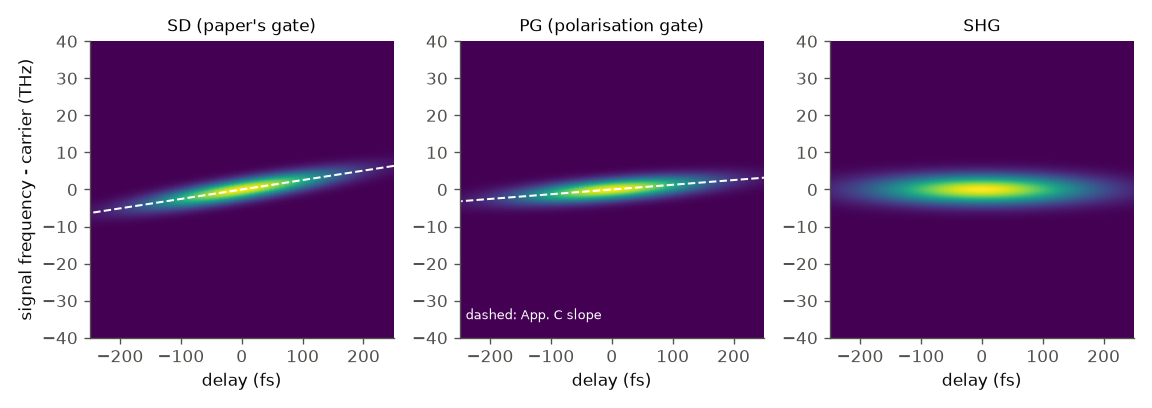
The three traces of the same pulse. SD and PG tilt; SHG does not (and is mirror-symmetric in delay).
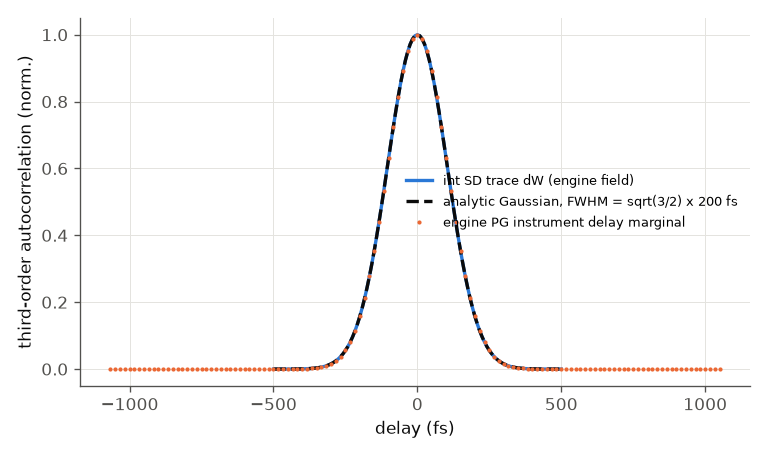
Integrating the SD trace over frequency gives the third-order autocorrelation of the paper (blue), a Gaussian of FWHM sqrt(3/2) x 200 fs (dashed); the engine's PG delay marginal (orange) is the same curve.
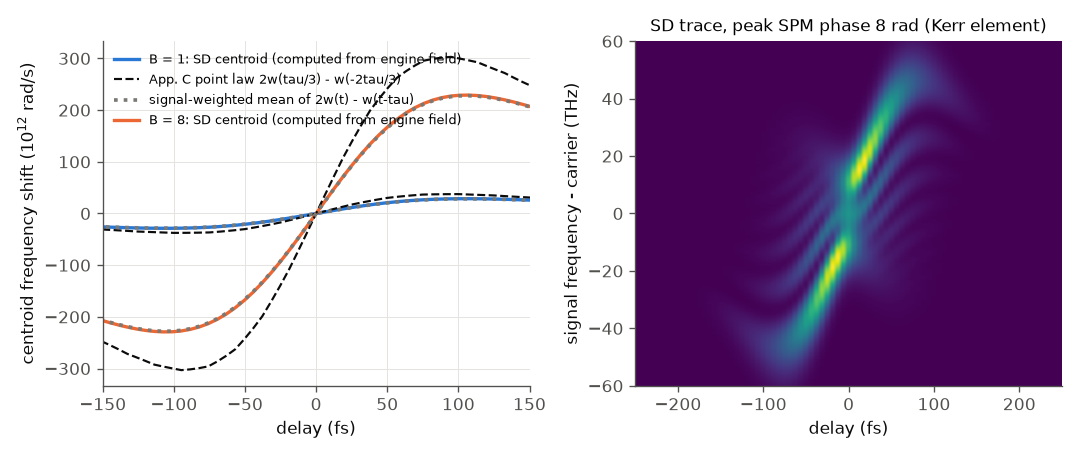
Weak and strong self-phase modulation (the paper's Figs. 3-4 use Q = 1 and Q = 8; the text has no definition of Q, so we read it as the peak SPM phase B = 1, 8 rad: UNVERIFIED). Left: the centroid of the SD trace against Appendix C's point law 2 w(tau/3) - w(-2 tau/3) (dashed) and against the same law averaged over the signal (dotted). Right: the SD trace at B = 8, with the fringe structure the paper attributes to the phase at two different times.
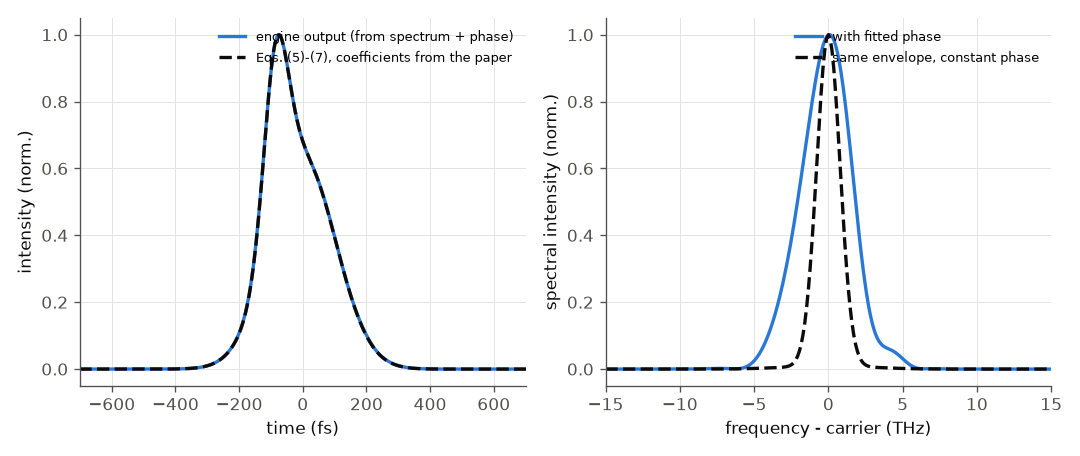
The pulse of Eqs. (5)-(7), the engine's reconstruction of it from spectrum and phase (left, indistinguishable), and its spectrum with and without the fitted phase (right).
Commentary and disagreements
- Appendix C is exact for linear chirp and only approximate otherwise. For the chirped Gaussian the 4/3 and 2/3 factors come out to 1e-13. For a nonlinearly chirped (SPM) pulse the point law 2w(tau/3) - w(-2tau/3) misses the trace centroid by 28 % (rms, of the maximum; B = 1 and 8), but the signal-weighted average of 2w(t) - w(t - tau) over the signal intensity E^2 E* matches to 0.5-0.9 %. The paper says the law holds for "not-too-pathological pulse shapes", so this is a statement about its range, not an error. Mean frequency versus delay still reveals the sign and shape of the chirp.
- "Negligible spectral broadening" in BK-7 (p. 574) is qualitative in the paper. With the engine library's n2 = 3.4e-20 m^2/W the peak SPM phase is 0.26 rad and the spectral rms width of the chirped pulse grows by 8 % (FWHM by 13 %) because SPM adds chirp to an already chirped pulse. The engine's Kerr step agrees with a one-line numpy Kerr phase (3e-7). Whether 8 % counts as negligible cannot be decided from the text; the cubic-dependence claim and the observed spectra are UNVERIFIED (figures not seen).
- Not reproduced: the experimental trace and its fit residuals (no data), the 33 x 33 resampling and
Fig. 11's spectra. The paper's own retrieval algorithm is announced as future work in the paper; the engine's PCGPA
and ePIE (kinds
sd-frog,pg-frog,shg-frog) are used on the engine's own traces. - The checks in
checks.jsoncompare the engine with the paper's appendix laws and with analytic Gaussian results. The B integral and peak-intensity checks of the BK-7 window are hard (they use the paper's 25 GW/cm^2 and the library n2); the fitted-pulse numbers that come from the text layer, and the random-seed sign check of the SHG retrieval, are soft (hard: false). - API pitfall found earlier, now fixed in the engine:
uf.retrieve("pcgpa", dict)withoutkindused to run an SHG retrieval on a PG trace silently. It now stops with an error that asks for the kind (checked: asymmetry 60 % -> error). - Changed since the last version of this folder: the SD gate and
sd-frogretrieval are now engine features (the numpy SD trace was the only workaround). The other numbers did not move: a fast-tier re-run of the oldrun.pygave the same values (B = 0.2551 rad, centroid slopes, fitted pulse 204.3 fs). One README value was stale before this update: the PG retrieval was quoted as GDD +6246.6 fs^2, G = 7e-6, but the engine gave +6240.2 fs^2, G = 6e-5 in the results already on disk (0.1 % from the truth; the cause is a retrieval or carrier change of the engine, not investigated further). The input pulse is now built at the requested carrier (engine stream 1); it changes nothing here because every quantity is an envelope quantity.
How well the science matched
Classification of the reasons: A = the paper does not specify inputs (assumption), E = erratum or internal inconsistency in the paper, L = engine limitation (named), B = engine bug (named), U = UNVERIFIED reading (the figure was not seen).
| quantity | paper | ours | verdict | most likely reason |
|---|---|---|---|---|
| SD trace tilt (chirp rate x 4/3) | App. C: 4/3 | 1.3333 (engine and numpy) | agrees | none needed |
| PG trace tilt (chirp rate x 2/3) | App. C: 2/3 | 0.6667 | agrees | none needed |
| SHG trace symmetric; direction of time ambiguous | App. B | asymmetry 4e-16; both signs of GDD in 12 seeds | agrees | none needed |
| SD / PG retrieval with no ambiguity | text on SD, PG | sign right in all seeds; GDD within 1.5 % for all 6 PCGPA seeds (5 within 0.2 %), within 4.2 % for all 6 ePIE seeds | agrees | none needed (a spectral-wing phase fit gives noisy GDD for ePIE: our metric, not an engine fault) |
| SD centroid law 2w(tau/3) - w(-2tau/3) for nonlinear chirp | "not-too-pathological pulses" | 28 % rms miss at B = 1 and 8; the intensity-weighted law matches to 0.5-0.9 % | partly | A: the paper does not define Q (read as peak SPM phase, U); the law is an approximation, not an error |
| "negligible spectral broadening" in 3 mm BK-7 at 25 GW/cm^2 | p. 574, no number | B = 0.255 rad, rms width +8 %, FWHM +13 % | partly | A: no definition of "negligible" and library n2 used; U: observed spectra not seen |
| fitted pulse (Eqs. 5-7): 200 fs, chirp factor about 2, spectrum narrower without the phase | p. 575 and Fig. 10 text | 204.3 fs, 2.07, 1.94 | agrees | coefficients from a text layer (OCR risk, U) |
| measured trace, 1.9 % fit rms, 33 x 33 array, Figs. 5-11 | measured data | not reproduced | not testable | U / A: the data are not in the text; the figures were not seen |
Overall. Everything in the paper that is a law (Appendices B and C, the integral identity, retrieval ambiguity) is reproduced by the engine instruments and retrievers, now including the paper's own self-diffraction gate and its retrieval. What is not reproduced is data-bound: the measured traces, the fit residual and the figure shapes, which cannot be compared without the data. No engine problem was found in this folder. To close the gap one would need the measured SD trace (or the numbers behind Figs. 5-11) and the definition of Q for the SPM traces.