
Maker, Terhune, Nisenoff, Savage (1962): dispersion and focusing in optical harmonic generation
Which paper this is. The request named a "Bjorkholm-type" paper. The PDF in docs/papers/ with this title is the two-page Physical Review
Letters of Maker et al. (Phys. Rev. Lett. 8, 21 (1962)), the paper that first showed the "Maker fringes". That is what is replicated.
Reading status. Read in full (the third page of the PDF is blank). The text layer was read through macOS PDFKit; equations and figure labels were checked on page images at 1.8x. The PDF and its figures are not in the repository. The paper is qualitative: it has one equation, three figures and a handful of numbers.
What the paper did
- Quartz (Fig. 1). A ruby-laser beam passes through a 0.0308 in (0.782 mm) quartz plate that is tilted; the blue (second-harmonic) light oscillates with the tilt because the plate's optical thickness changes and the harmonic and its source polarisation drift out of phase. Spacing of the maxima expressed as a thickness change: 13.9 um calculated, 14 um measured.
- KDP (Fig. 2). An ordinary red ray can phase-match an extraordinary blue ray in KDP; the blue is 300 times stronger at theta_0 = 52 +- 2 degrees, phi_0 = 45 degrees (beam collimated within 1/4 degree).
- Focusing (p. 22, Fig. 3). A focused beam gives more blue; in KDP "a gain of 3000" which the authors split by rough calculation into 100 (smaller beam) times 30 (mixing of divergent rays), and the blue only appears for rays at theta >= theta_0 (a crescent in the far field). Photon ratios (red photons per blue photon): quartz 5e12 collimated, 6e10 focused; KDP 3e9 and 1e6. The authors say these depend on the laser's coherence.
What was run (run.py, fast tier about 4 min, full tier about 8 min)
- Quartz. A user crystal with Ghosh (1999) quartz indices (the same as the engine's
Quartzmaterial), SHG o o -> o at 694.3 nm (ruby wavelength assumed), thickness scanned from 0 to 60 um; then the 0.782 mm plate at rotations 0-40 degrees, modelled as the path d / cos(theta_r). The stepper tolerance is the default (1e-6); before 2026-11 it had to be 1e-11 (see "Fixed bugs"). - KDP. Phase-matching calculator and
crystalelement at the matched angle: theta_0, phi_0, the phi dependence, the angular width of 1.5 mm. - Focusing. 1.5 mm KDP in the cartesian transverse model (walk-off included), collimated (w0 300 um) and focused (w0 20 um), angle scan. The beam sizes are assumptions. The paper gives none.
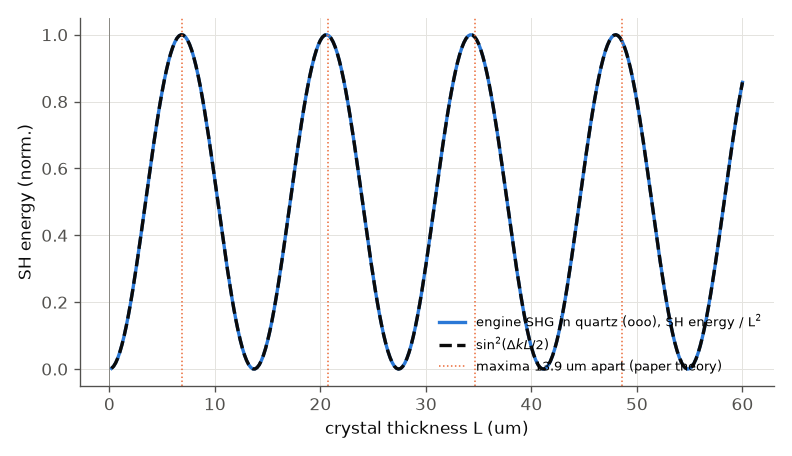
Engine SHG against plate thickness divided by L^2 (blue) lies on sin^2(dk L / 2) (dashed). The dotted lines are 13.9 um apart, the paper's spacing.
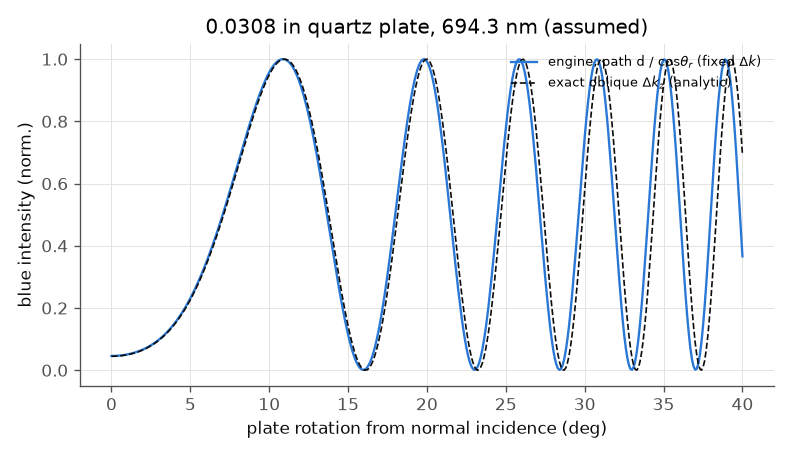
Blue light against tilt for the 0.782 mm plate. Blue: engine with path d / cos(theta_r) and the normal-incidence mismatch. Dashed: the exact oblique formula dk_z = (4 pi / lambda)(sqrt(n_2w^2 - sin^2 theta) - sqrt(n_w^2 - sin^2 theta)). The paper's curve (Fig. 1) is not redrawn. It shows about the same pattern of fringes getting closer together, but its envelope also has Fresnel and geometry factors that the engine does not have.
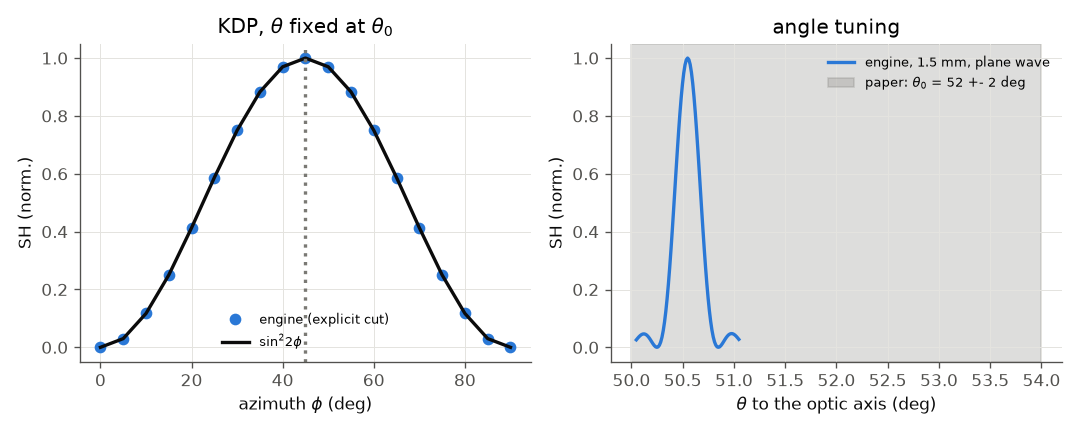
Left: SH against azimuth at the matched theta. The dots are the engine, the line is sin^2(2 phi); all 19 points lie on it (since the 2026-11 fix). Right: the angle tuning of a 1.5 mm plate (plane wave, 0.25 degree wide); the band is the paper's theta_0 = 52 +- 2 degrees.
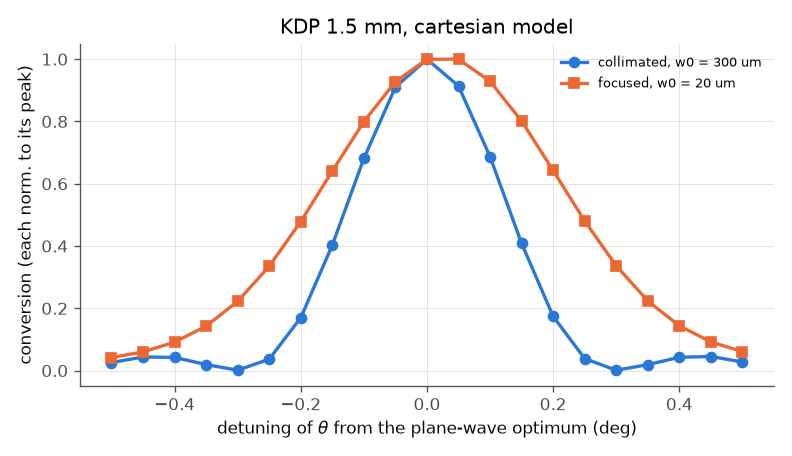
Conversion against detuning of theta, each curve normalised to its peak.
Paper against ours
| quantity | paper (location) | ours | verdict |
|---|---|---|---|
| quartz fringe spacing, o o -> o | 13.9 um calc., 14 um measured (p. 21, Fig. 1) | 13.71 um (scan and 2 pi / dk agree) | agrees to 1.4 % (1961 index data differ from Ghosh 1999) |
| same for the e e combination | 13.25 um | 4.7 % low: the ordinary-wave case is the one that fits | |
| SH energy vs thickness | sin^2(dk L) law (p. 21 equation) | within 0.01 % of sin^2 after dividing by L^2 (relative spread 1.0e-4, with the default stepper) | agrees |
| tilted plate, fringes between 0 and 40 degrees | not counted (read off Fig. 1: UNVERIFIED) | 6 maxima, path model and exact oblique formula agree on the count; total phase differs 2 % | consistent |
| KDP theta_0 | 52 +- 2 degrees (Fig. 2) | 50.55 degrees | agrees (1.5 degrees below, inside the quoted band) |
| KDP phi_0 | 45 degrees (Fig. 2) | 45 degrees | agrees |
| d_eff against phi | sin(2 phi) (p. 21, symmetry) | follows it at all 19 azimuths (0 off by more than 1 %); d_eff / (d36 sin(theta) sin(2 phi)) = 1.02379 at every phi, spread 6e-15, and sin(theta + rho)/sin(theta) = 1.02379 with rho = 29.44 mrad (1.69 degrees), the walk-off of the SH wave computed independently | agrees; the 2.4 % is the engine projecting onto the E vector instead of using the wave-vector angle |
| angular width, 1.5 mm KDP | about 1 degree on the figure's 5 degree scale bar (read off Fig. 2, UNVERIFIED; includes +-1/4 degree beam divergence) | 0.25 degree internal, plane wave | not comparable (external angle, divergence, thickness of that run not given) |
| 300-fold enhancement at the matched orientation | p. 21 | not computed: no baseline orientation or thickness is given | not reproduced |
| focusing: conversion ratio, focused / collimated | factor 100 from the smaller beam, plus 30 from mixing of divergent rays (p. 22) | 123 for an area ratio of 225: 0.54 of the 1/area law | opposite sign to the "30"; assumed beam sizes |
| focused curve is broader and, near theta_0, one-sided | blue only for theta >= theta_0 (p. 22, Fig. 3) | FWHM 0.35 against 0.20 degrees; skew at +-0.2 degrees: 0.15 (focused), 0.01 (collimated) | qualitative agreement; far-field crescent not extracted |
Commentary
Dispersion. The paper's equation S = 2 pi c P^2 (k_b / dk)^2 sin^2(dk x) is the plane-wave result. The engine reproduces it with a period of 2 pi / dk = lambda / (2 (n_2w - n_w)); the printed 13.9 um is that spacing, not the coherence length (half of it, 6.9 um). The fringes in thickness are what rotating the plate scans.
Quartz geometry. The text says the red is polarised parallel to z while the plate turns about z. For a crystal of class 32 an electric field along its optic axis alone does not drive any second-order polarisation (d33 = 0), so "z" here probably is not the optic axis of today's convention. The ordinary-wave interaction (d11, o o -> o) is the one whose spacing matches 13.9 um. I did not investigate this further.
Focusing. The engine's cartesian model carries each wave's walk-off, which is the first-order angular dependence of the extraordinary index. With it the focused curve is broader (0.35 against 0.20 degrees) and has a small skew, which is the beginning of the effect behind Fig. 3. The conversion is 123 times higher for a beam 15 times narrower (225 times smaller in area): the 1/area law holds to a factor 0.54, the rest being lost to the beam's angular spread (0.64 degrees for a 20 um waist, more than the 0.27 degree acceptance). The paper's extra factor 30 from "mixing of divergent rays" does not appear; this is not a contradiction, because the 1962 beams were multimode, uncollimated ruby-laser beams. The engine has no model of the second-order index surface curvature, only the walk-off term, and the far-field crescent (Fig. 3) is not extracted.
Fixed bugs (found by this replication, fixed in the engine 2026-11; repro_1.py, repro_2.py deleted)
- Erratic d_eff in the KDP crystal element (B8). With an explicit cut the reported
deffPmPerVwas not a smooth function of phi (7 of 19 azimuths wrong, 0.224 pm/V at phi = 45 against 0.308); the ordinary-mode eigenvector came from rounding noise. Now 0 of 321 azimuths (0.25 degree steps) are anomalous, the explicit cut at phi = 45 gives the same conversion ascut: "auto"(ratio 1.000, was 0.73), and d_eff follows d36 sin(theta + rho) sin(2 phi). The constant 2.4 % relative to the textbook d36 sin(theta) sin(2 phi) is the walk-off projection (hard check against the independently computed walk-off). - The adaptive stepper did not resolve a strongly phase-mismatched thick crystal. A 0.8 mm quartz plate (dk L = 370 rad) gave SH energies 150-960 times above the plane-wave law with no warning;
run.pyused a tolerance of 1e-11 as a workaround. Now the default tolerance gives the law to 0.2-3 % in the old reproduction (746 steps, the step is capped at 0.5 rad of mismatch phase), andrun.pyuses the default.
What is missing
- Fresnel factors and refraction at a tilted face (engine has normal incidence), so the envelope of Fig. 1 is not reproduced, only the fringe positions.
- The far-field blue pattern of Fig. 3 (the crescent bounded at theta_0), and the paper's photon-ratio table.
All other numbers in the table above are identical to the previous engine (13.71 / 13.25 um, 6 maxima, 50.55 degrees, 0.25 degree width, gain ratio 123, FWHM 0.35 / 0.20, skews 0.15 / 0.01), re-run in the full tier.
How well the science matched
| quantity | paper | ours | verdict | most likely reason |
|---|---|---|---|---|
| quartz fringe spacing (dispersion) | 13.9 um calc., 14 um measured | 13.71 um (ooo) | agrees (1.4 %) | 1962 index data vs Ghosh 1999; polarisation geometry of the paper unclear (UNVERIFIED reading: the o o -> o interaction is the one that fits) |
| sin^2 law of SH against thickness | p. 21 equation | follows to 0.01 % | agrees | |
| fringes of the tilted plate | read off Fig. 1 (UNVERIFIED) | 6 maxima over 0-40 degrees; path model and exact oblique formula agree | partly | engine has normal incidence only (engine limitation: no oblique incidence, no Fresnel factors), so only the fringe positions |
| KDP phase-matching angle | 52 +- 2 degrees | 50.55 degrees | agrees | Zernike indices vs the 1962 crystal |
| KDP phi_0 and d_eff proportional to sin 2 phi | 45 degrees | 45; follows sin 2 phi at 19 of 19 azimuths (after fixing B8) | agrees | was an engine bug (fixed) |
| angular width of the tuning curve | about 1 degree external (read off Fig. 2, UNVERIFIED) | 0.25 degree internal, plane wave | not comparable | beam divergence of 1/4 degree and external angle in the paper; no thickness given (assumption) |
| 300-fold enhancement at the matched orientation | p. 21 | not computed | UNVERIFIED reading | no baseline orientation or thickness given |
| focusing gain 3000 = 100 x 30 | p. 22 | 123 for an area ratio 225 (0.54 of the 1/area law); no extra factor 30 | does not (the 30) | paper gives no beam sizes or coherence (assumption); the 1962 ruby beams were multimode; the engine has the walk-off but not the second-order index-surface curvature (engine limitation) |
| focused curve broader and one-sided | Fig. 3 | FWHM 0.35 vs 0.20 degrees; skew 0.15 vs 0.01 | agrees (qualitative) | |
| far-field crescent, photon-ratio table | p. 22, Fig. 3 | not extracted | UNVERIFIED reading | needs a far-field detector on the cartesian run |
Overall: the dispersion physics (the fringe period and the sin^2 law) is reproduced to 1.4 % and the KDP angles and azimuth law are reproduced; both engine bugs this paper exposed (the erratic d_eff and the stepper in a thick mismatched crystal) are fixed and the workarounds are gone. The focusing part is only qualitative because the paper gives no beam data. To close the gap one needs the paper's beam geometry and coherence, oblique incidence with Fresnel factors, and a far-field detector for the crescent.