
Perot and Fabry (1899): multiple-beam fringes, coincidences of two lines, resolving power
This is not the paper that was asked for. The file supplied as "Michelson 1892, On the application of interference phenomena to the solution of various problems of spectroscopy and metrology" has that title, but its author line reads A. Perot and Charles Fabry, Astrophysical Journal 9, 87 (1899) (translated from Bulletin Astronomique). It describes what is now called the Fabry-Perot interferometer. Michelson's 1892 work on fringe visibility versus path difference and line widths was not available to read, so any number attributed to it is UNVERIFIED and no check depends on it. (This paper cites Michelson's visibility curves and says its own two-line results reproduce them, p. 100; no numbers are given there.)
Reading status. The Read tool's PDF mode failed (poppler is missing). The scan was read through macOS PDFKit: an OCR text layer for the prose, page images for formulas and numbers (pp. 91, 92, 99 were checked on the images). The prose was read in full to p. 112; pp. 112-115 (long lengths, standard films) were only skimmed and are not used. Page numbers are the journal's.
What the paper does
Two silvered, parallel, plane plates send light back and forth many times. The transmitted waves have path differences Delta, 2 Delta, 3 Delta, ... (Delta = 2 e cos i for plate spacing e), with amplitudes falling geometrically, so the fringe is a narrow bright line instead of a cosine (p. 91): I = I0 / (1 + (4f/(1-f)^2) sin^2(pi Delta/lambda)), f the reflecting power of each plate; for f = 0.8 the coefficient is 80. Two near lines give two fringe systems that coincide and separate periodically; the period in path difference is Omega = lambda lambda'/(lambda - lambda') (pp. 96-98). The paper uses coincidences to find the order of a fringe and to compare wavelengths (Hg against Cd lines), and reads the resolving power from the order: two lines are clearly separate when their rings are 1/5 of a ring spacing apart (p. 99).
What the engine can and cannot do
- Simulable: the etalon as a branched system (two
beamSplittermirrors, twogaps, aringDownloop; the engine's ownFabryPerot_LoopGivesTheAiryFunctiontest and example 32 use the same graph), driven by a single-frequency source. Lines are mutually incoherent, so each is run separately and the transmitted intensities add. - Not simulable here (and not attempted): rings in convergent light (Delta = 2 e cos i; this needs a spatial model), the silver's absorption (the mirrors here are lossless, so I0 = 1), the white-light superposition fringes of two plates, the standard films and the long-length measurements, the plate-parallelism adjustment and every instrument detail.
- Note: the engine moves a cw source's wavelength to a sample of its frequency grid. With the default window that is up to 3e-7
relative, which is not negligible for lines 1e-6 apart.
run.pysets a 1 microsecond window (shift below 1e-9). Re-checked after the 2026-11 grid fix (pulses are now built at the requested carrier): a cw source is a single grid line, so it still sits on the nearest bin (measured: fringe spacing 2.8e-7 off the requested wavelength at the default window, 6e-10 with the 1 us window, also withsnapCarrier: false). The workaround stays; it is an engine limitation of cw sources, harmless once known.
Run: python run.py --tier fast (about one minute, a few thousand cw runs); mirrors R = 0.8 (and 0.9 for the bright-part remark).
The fringe spacing of each line is measured from the positions of two peaks 2 mm and 4 mm of path difference apart (about 4000
orders), refined by a parabola; the period of coincidence follows from the two measured spacings.
Comparison
| quantity | paper | ours |
|---|---|---|
| coefficient 4f/(1-f)^2, f = 0.8 | 80 (p. 91) | 80 (formula); engine curve matches the Airy function to 3e-7 |
| I_max (no absorption) | I0 (p. 91) | 0.9999997 of the incident |
| I_max / I_min | 1 + 80 = 81 (from the formula) | 81.0 |
| FWHM of a fringe / spacing, R = 0.8 | not given | 0.07133 (formula 0.07133) |
| bright part of a fringe | "not more than 1/20 of the interval" (p. 92, no f given) | FWHM 1/14 at R = 0.8 and 1/30 at R = 0.9; 1/20 needs R >= 0.855 (read as FWHM; soft) |
| period, Hg yellow doublet | 311.9 Cd-green waves (p. 102) | 311.914 |
| period, Cd green / Hg green | 14.56515 (p. 102) | 14.56515 |
| period, Cd green / Cd red | 4.759901 (p. 103) | 4.759902 |
| period, Na D lines | "about 1000" (p. 98) | 987 (from tabulated D wavelengths; soft) |
| ring offset when lines are 1e-5 apart, e = 5 mm | 1/5 of the spacing at p = 20,000 (p. 99) | 0.2000 of the spacing at p = 19,999 |
| the same at e = 5 cm (eps/lambda = 1e-6) | 1/5 at p = 200,000 (p. 99) | 0.2000 at p = 199,861 (the engine's eps/lambda is 1.0007e-6) |
| two lines at that separation | "clearly visible" (p. 99) | two distinct peaks; valley at 22 % of the peak of the sum |
The coincidence periods reproduce to the paper's printed digits: they are fixed by the wavelengths, and the engine's etalon peaks sit exactly lambda apart (to 1e-9). The agreement of the two-line comparison therefore tests that the etalon's fringe lattice is exact over thousands of orders and that two incoherent systems add correctly. The Airy rows test the engine's loop against the paper's formula. No disagreement was found.
One reading check: the coincidences seen directly in the engine's two scans (figure, left) are found from the product of the two patterns at multiples of the period to within 0.13 of a period (a soft check: the fringe spacing is 0.21 of the Cd-green/Cd-red period, so the position of a coincidence is only defined to about that).
Plots
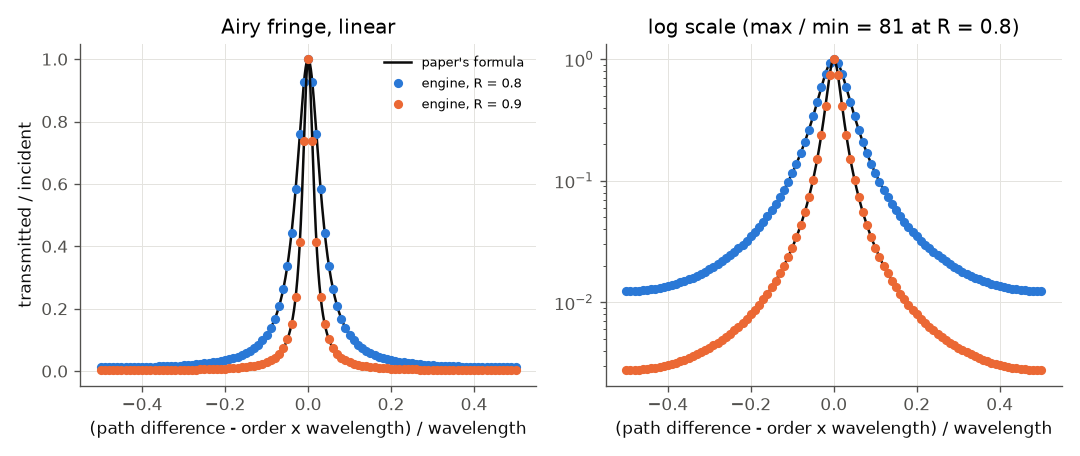
The fringe of one order for R = 0.8 and 0.9 (linear and log scales). Black: the paper's formula; points: the engine's etalon.
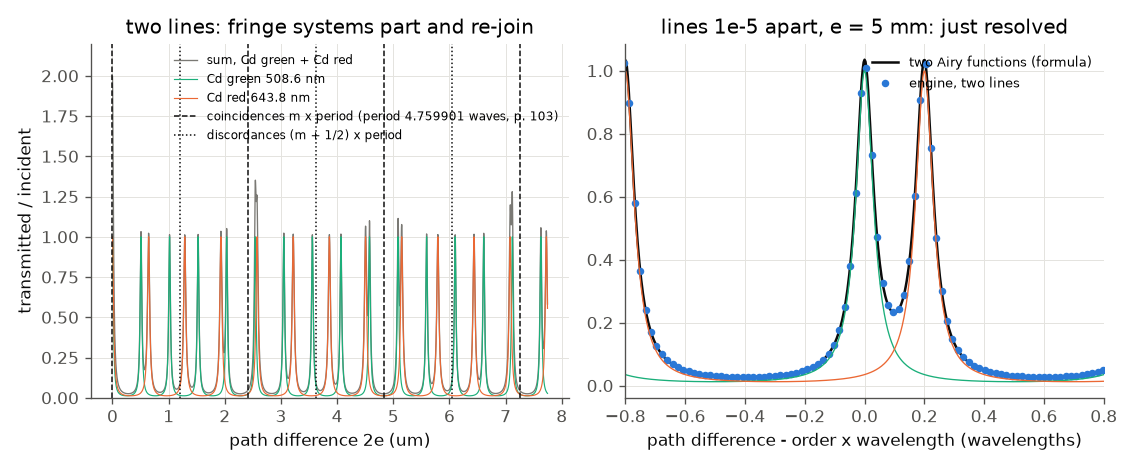
Left: transmission of the two Cd lines (green, orange) and their sum (grey) against path difference. Dashed lines: coincidences at multiples of the period 4.759901 Cd-green waves; dotted: discordances at half-integer multiples. The systems separate, then re-join. Right: two lines 1e-5 apart, at the order p = lambda/(5 eps) (e = 5 mm): their fringes are 1/5 of a spacing apart and the sum shows two peaks, the paper's criterion for "just resolved". Black: the sum of two Airy functions.
What does not reproduce / what is left
- Nothing disagrees. The silver absorption, rings in convergent light, white-light superposition fringes and the length measurements (pp. 108-115) are not simulated.
- Michelson's 1892 paper: not available, not replicated. Fringe visibility versus path difference for a source with structure
(the Michelson interferometer) is exercised in the sibling folder
michelson-1887-ether-null(white-light visibility envelope against the analytic Gaussian result), but that is not a check of any value from the 1892 paper.
How well the science matched
Re-run after the 2026-11 engine fixes: all 19 checks pass with the same numbers as the table above. The carrier-snapping workaround (1 microsecond window) was
re-examined and is still needed: the fix builds pulses at the requested carrier, but a cw source is one grid line and still sits on the nearest bin
(snapCarrier: false does not change it). A transverse (cartesian) Fabry-Perot ring check was not attempted.
| quantity | paper | ours | verdict | most likely reason |
|---|---|---|---|---|
| Airy fringe, coefficient 80 at f = 0.8 | p. 91 | 80; curve matches to 3e-7 | agrees | |
| bright part of a fringe "not more than 1/20" (p. 92) | silver, f about 0.90 | FWHM 1/30 at R = 0.9, 1/14 at R = 0.8 | agrees at 0.9 (soft) | paper does not specify inputs: f is not given at that point, and "bright part" is read as FWHM (assumption) |
| coincidence periods (Hg yellow, Cd green/Hg green, Cd green/Cd red) | 311.9; 14.56515; 4.759901 | 311.914; 14.56515; 4.759902 | agrees | fixed by the printed wavelengths; the test shows the engine's fringe lattice is exact over thousands of orders |
| Na D period | "about 1000" (p. 98) | 987 | agrees (soft) | paper gives no wavelengths; tabulated D lines assumed |
| resolving power, 1/5 spacing | p = 20,000 at e = 5 mm; 200,000 at 5 cm | 19,999; 199,861 | agrees | the 5 cm case differs by 7e-4 because the engine's eps/lambda is 1.0007e-6 (cw frequency snap of the second line) |
| silver absorption, I_max < I0 | discussed (p. 92) | lossless, I_max = I0 | not tested | engine limitation: mirrors are lossless in this graph (a beamSplitter with loss could be tried) |
| rings in convergent light, Delta = 2 e cos i | the paper's main observation | not simulated | not tested | engine limitation here: needs a transverse model; a cartesian-grid etalon was not tried |
| standard-film and long-length measurements (pp. 108-115) | numbers given | not used | not tested | UNVERIFIED: only skimmed; the OCR was garbled for tables |
Overall judgement. The engine reproduces the paper's spectral content completely: the Airy lineshape, the geometry of coincidences and the resolving-power criterion are matched to the printed digits. What is not covered is everything about the real apparatus: silver absorption, rings with angle, plate defects and the metrology of lengths. Closing the gap needs lossy mirrors in the etalon graph and a transverse (cartesian-grid) Fabry-Perot with a tilted or converging beam. Note that this is the Perot-Fabry paper, not the Michelson 1892 paper that was requested; the latter remains unread.