
Treacy (1969): optical pulse compression with a grating pair
Reading status. The Read tool's PDF mode failed (poppler is missing). The licensed IEEE PDF (5 pages) was read through macOS PDFKit; its text layer garbles the equations, so every formula and number was read from page images (eq. (17) at four times magnification). The PDF and its figures are not in the repository.
What the paper does
Two parallel gratings, light passing the pair once, delay longer wavelengths more, so the phase shift through the pair has a quadratic term in frequency: a chirped pulse of the right sign is compressed. The paper derives the group delay tau_0 = b (1 + cos theta)/c (eq. 7) from the geometry (slant separation b, angle theta between the incident and diffracted rays, sin(gamma - theta) = lambda/d - sin gamma, eq. 3), and the chirp rate
1/mu = 4 pi^2 c b / (omega^3 d^2 [1 - (lambda/d - sin gamma)^2]) (eq. 8, phi'' = -1/mu)
The output of the pair for an input envelope A exp(i psi) is a Fresnel transform (eq. 14), the same integral as Fresnel diffraction, with the grating separation b playing the part of the propagation distance (Table I). The worked example (p. 456): 1200 lines/mm, 1.06 um, 60 degrees; two wavelengths 100 A apart are delayed by 0.58 ps per cm of slant separation; a pulse with a linear sweep over a 100 A band and 5.8 ps duration is compressed to its minimum at b = 10 cm. The last section (eq. 17) adds the cubic term sigma (omega - omega_0)^3, "of order twice the fractional bandwidth" relative to the quadratic one.
Setup in the engine
gratingPair with linesPerMm: 1200, aoiDeg: 60, order: -1, passes: 1 (the engine's default is 2, a double-passed
compressor, which would double the dispersion), and separationM = G, the perpendicular distance; Treacy's b is the slant
separation, so G = b cos(theta_d) with theta_d = 23.95 degrees the diffraction angle (equal to gamma - theta of eq. 3).
The input is a Gaussian at 1.06 um with 10 nm FWHM of its intensity spectrum (an assumption for the "100 A band"), 165 fs
transform limit, and a group-delay dispersion of +3.46e5 fs^2 that makes it 5.8 ps long. Positive GDD means longer wavelengths
first; the pair delays them more, so it compresses this pulse and lengthens one with the opposite chirp (11.9 ps in the run), which
confirms the sign convention end to end. Grid: 16384 points, 60 ps window (3.7 fs step). Run python run.py --tier fast (about
20 s) or --tier full --figures.
Comparison
| quantity | paper | ours |
|---|---|---|
| group delay at b = 10 cm, eq. (7) | tau_0 = b (1 + cos theta)/c | engine 603.271 ps; eq. (7) 603.264 ps (1e-5) |
| GDD at b = 10 cm, eq. (8) | -1/mu | engine -3.6364e5 fs^2; eq. (8) -3.6367e5 fs^2 (8e-5) |
| TOD at b = 10 cm, exact phase | not given | engine 9.935e-40 s^3; numerical derivative of eq. (4)/(7) 9.936e-40 (1.3e-4) |
| TOD, eq. (17) as printed | sigma = (2 omega_0 mu)^-1 (1 + (lambda/d) sin gamma + sin^2 gamma) | 1.751e-39 s^3, 1.76 times the exact value (see below) |
| delay per cm for 100 A, eq. (5a) | 0.58 ps/cm (p. 456) | 0.610 ps/cm from the engine and from eq. (5a) itself (+5 %) |
| compression optimum | b = 10 cm (p. 456) | 9.51 cm (engine scan; the chirp divided by eq. (8)'s rate: 9.51 cm) |
| minimum duration | "compressed to its minimum length" | 182.5 fs (165.4 fs transform limit; 1.10 times, from the cubic phase) |
| pulse before, after | 5.8 ps, minimum | 5.80 ps, 182.5 fs: factor 32 |
| angular dispersion per 100 A (p. 457) | about 2e-2 rad (read from a scan) | 1.313e-2 rad: the engine's own report (trackedAngularDispersionXRadPerM of a single grating) equals 1/(d cos theta_d) x 100 A to 1e-15 |
Disagreements, and where they come from (none is in the engine)
- Printed example, 0.58 ps/cm. Equation (5a), evaluated with the paper's own numbers, gives 0.610 ps/cm, and the engine agrees with the equation to 1e-4. The printed value is 5 % lower, and the 10 cm for a 5.8 ps pulse follows from 0.58 (5.8 ps / 0.58 ps/cm), whereas the formula gives 9.5 cm. A rounding or a different wavelength spacing in the paper's arithmetic; the engine follows the equation. No tuning was done.
-
Equation (17). The coefficient of the cubic phase, as printed, is 1.76 times the exact derivative of the paper's own group delay (eq. 4/7, at fixed perpendicular separation G, so b varies with wavelength). The engine (9.935e-40 s^3) agrees with the numerical derivative to 1.3e-4. Differentiating eq. (5b) once more by hand gives, with the dependence of b on wavelength kept,
phi''' = 3 |phi''| / omega_0 x (1 + (lambda/d) sin gamma - sin^2 gamma) / cos^2 theta_d
(checked against the numerical derivative to 7e-8). The printed form has "+ sin^2 gamma" and no 1/cos^2 theta_d. This is a statement about the
printed equation in this copy, not about the engine; a later erratum or correction may exist, which was not looked for. The size of the cubic
effect decides how far a real pulse compresses: with the exact phase, at the optimum b the minimum duration is 182.5 fs, 10 % above the
165 fs transform limit; the quadratic-only closed form would say 165 fs.
3. Angular dispersion "about 2e-2 rad per 100 A" (p. 457): the grating equation gives 1.313e-2 rad. Re-examined after the 2026-11 fix of the
grating angular-dispersion report: the engine's tracked-beam report for a single 1200 l/mm grating at 60 degrees, 1.06 um is now
-1.31308e6 rad/m, i.e. 1.3131e-2 rad per 100 A, identical to the grating equation (a hard check, angularDispersion_engineOverFormula). So the
earlier figure was not an engine report error, and the engine does not explain the paper's number either. The gap (factor 1.5) is on the paper's
side or in our reading: the exponent was read from a scan and the paper calls it approximate. Nothing in the stated numbers (1200 lines/mm, 60 degrees,
1.06 um, 100 A) yields 2e-2 from the grating equation. Status: unresolved, UNVERIFIED reading.
Plots
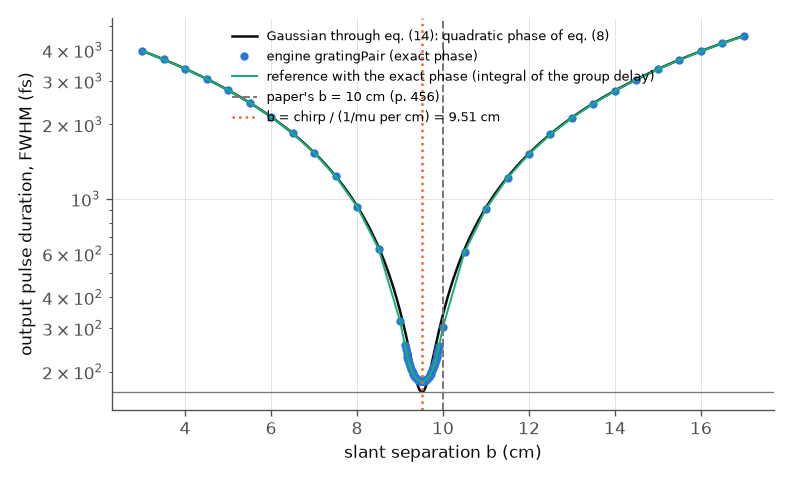
Output duration (FWHM, fs) against slant separation. Black: the closed-form Gaussian through the paper's quadratic phase (eq. 8, eq. 14); green: a
reference computed in run.py with the exact phase (the integral of the exact group delay over frequency); blue points: the engine. Vertical
lines: the paper's 10 cm (grey) and the separation at which the pair's chirp cancels the pulse's (orange, 9.51 cm). The engine follows the exact-phase
reference to 0.2 % everywhere; both sit above the horizontal transform limit at the minimum because of the cubic phase.
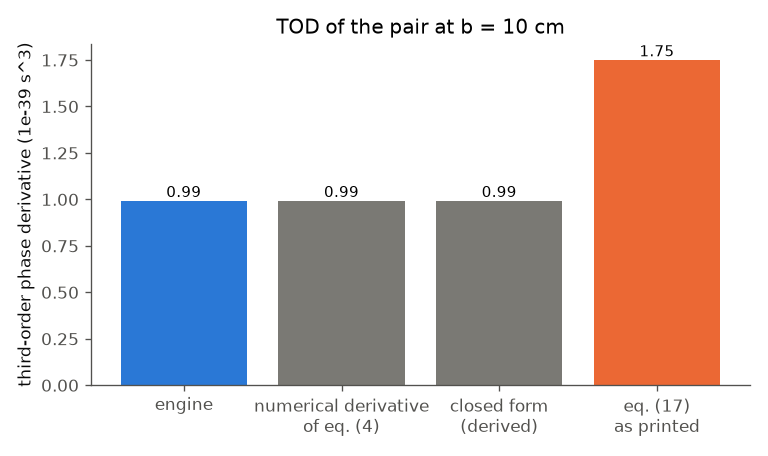
Third-order phase derivative at b = 10 cm: the engine, the numerical derivative of the paper's eq. (4), the closed form derived above, and eq. (17) as printed.
What does not reproduce / what is left
- The two printed numbers (0.58 ps/cm, 10 cm) and the eq. (17) coefficient differ from the paper's own formulas, as above; the engine follows the formulas.
- Not simulated: finite resolving power and grating size (p. 457), efficiency, beam walk-off between the gratings (spatial chirp; the engine's
gratingPairwithpasses: 1leaves it, seedocs/reference/components.md), and the paper's Table I Fresnel analogy beyond the Gaussian case. - The sign of Treacy's convention (exp(-i omega t)) was not compared symbol by symbol; the physical statement (positive chirp is compressed, negative lengthened) was tested instead.
How well the science matched
Re-run after the 2026-11 engine fixes: every number above is unchanged (the pair uses the engine's exact grating phase; the only new item is the engine-report check of the angular dispersion). The scan was read from page images; the OCR text layer garbled all equations.
| quantity | paper | ours | verdict | most likely reason |
|---|---|---|---|---|
| group delay tau_0 (eq. 7) | b (1 + cos theta)/c | 603.271 ps vs 603.264 ps | agrees | (engine reproduces the formula to 1e-5) |
| chirp rate / GDD (eq. 8) | -1/mu | -3.6364e5 vs -3.6367e5 fs^2 | agrees | |
| compression of a linearly swept pulse, sign | positive chirp compressed | 5.8 ps -> 182.5 fs; opposite chirp 11.9 ps | agrees | |
| delay per cm for 100 A (p. 456) | 0.58 ps/cm | 0.610 (engine and eq. 5a) | partly (5 % off) | paper erratum / internal inconsistency: the paper's own eq. (5a) gives 0.610. Could also be a misread digit (UNVERIFIED: scan) |
| optimum separation (p. 456) | 10 cm | 9.51 cm | partly | follows from the 0.58 above (5.8 ps / 0.58); same cause |
| cubic phase, eq. (17) | sigma = (2 omega_0 mu)^-1 (1 + (lambda/d) sin gamma + sin^2 gamma) | printed form is 1.76 x the exact derivative; engine matches the derivative to 1.3e-4 | does not (printed form) | paper erratum / internal inconsistency, or UNVERIFIED reading of the sign and of a possible 1/cos^2 theta_d factor at 4x magnification. Reading the sign as minus would still leave a 1.2 x gap, so a pure misread is unlikely. Not an engine issue |
| minimum duration with the cubic term | not quoted | 182.5 fs (1.10 x transform limit) | not comparable | paper does not specify inputs (our 10 nm bandwidth is an assumption for the "100 A band") |
| angular dispersion per 100 A (p. 457) | about 2e-2 rad | 1.313e-2 rad (engine report = grating equation) | does not (x1.5) | not an engine bug (report verified exact); UNVERIFIED reading of the exponent, or the paper's loose figure |
| resolving power, grating size, spatial chirp (p. 457) | discussed | not simulated | not tested | engine limitation: gratingPair with passes 1 is the exact temporal phase only; finite aperture and beam walk-off are not modelled |
Overall judgement. The engine reproduces every quantity that can be computed from the paper's equations (group delay, GDD, TOD, optimum separation, compression against separation) to 1e-4 or better, and exposes three places where the printed paper is inconsistent with its own formulas (0.58 ps/cm, 10 cm, eq. 17) plus one number (angular dispersion) it cannot reproduce. None of them is an engine fault as far as we can tell. To close the gap: the original journal scan or an erratum list (to settle eq. 17 and p. 457), and a model of finite grating width and spatial chirp for the resolving-power discussion.