
01 -- SPM in a fused-silica plate
The smallest complete example: an AR-coated 6.35 mm fused-silica plate with the beam focused to its centre.
ultrafast run plate.ufs run.json -o results
What to look at:
results/summary.json->elements[1]: B-integral of the plate (~0.6 rad), solver statistics,criticalPowerRatio.instruments: the spectrometer shows SPM broadening;ideal_compressorreports the GDD that would compress the broadened pulse and the resulting duration.lossBudget: the two AR coatings (0.2 % each).provenance.json: where every model came from (built-in Malitson index, built-in n2 = 2.6e-20 m^2/W, ...).
Try an override without touching the system file -- add to run.json:
"overrides": [ { "target": "material:FusedSilica", "property": "n2", "value": 2.2e-20 } ]
Note: the peak power is above the critical power for self-focusing in silica; the engine warns because the plate
is simulated in 1-D. Add "transverse": {"model": "radial"} to the plate to resolve diffraction and Kerr lensing
(see example 11 and docs/transverse.md).
Result
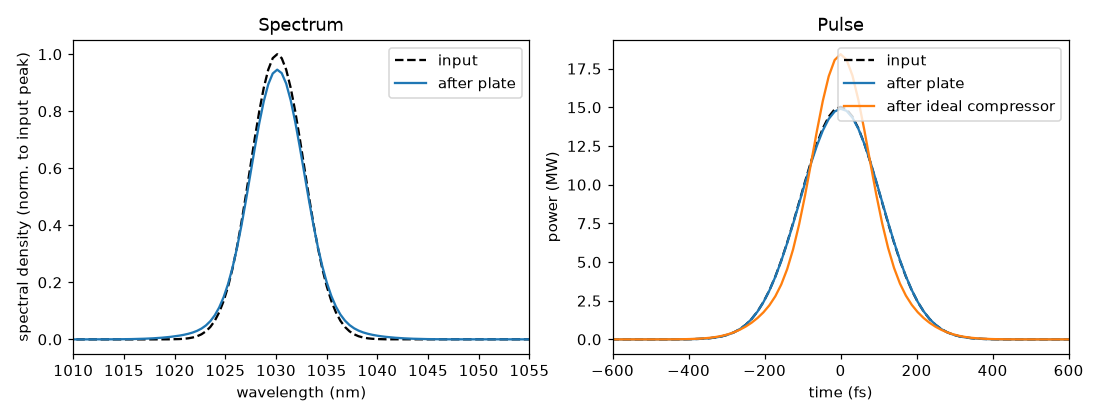
python plot.py draws this figure from results/. A 250 fs, 4 uJ pulse crosses the plate with a B-integral of
0.667 rad. The Kerr effect adds a phase proportional to the instantaneous power, which creates new frequencies:
the spectrum (left) gets weak wings and a lower peak, and its FWHM is 6.37 nm. The pulse (right) is almost
unchanged in time (251.5 fs FWHM) because SPM only changes the phase.
The ideal compressor removes the remaining chirp and shortens the pulse to 189 fs with a peak power of 18.4 MW,
close to the 184 fs transform limit of the broadened spectrum: the extra bandwidth is real and can be used.