
09 -- Non-collinear OPCPA in BBO
A 15 fs (transform-limited) 800 nm seed, stretched to ~0.6 ps, is amplified in 2 mm of BBO pumped by the 515 nm
second harmonic from example 08. Run example 08 first: the pump is read from its saved results
("from": "../shg-lbo/results"), so the pump has the exact temporal and spectral shape that the SHG produced.
(cd ../shg-lbo && ultrafast run shg.ufs run.json -o results)
ultrafast run nopcpa.ufs run.json -o results
ultrafast-plot results
How the crystal is set up:
"process": "opa", main beam = the signal (the run's pulse), aux beam = the pump. The idler is generated."noncollinearDeg": "magic"solves for the pump-signal angle at which the idler's group velocity projected on the signal direction equals the signal's (2.56 deg);"cut": "auto"then phase-matches at the nominal wavelengths (signal at 22.0 deg to the optic axis, i.e. a crystal cut for the pump at 24.6 deg)."delayS": "auto"centres the pump on the signal. ThedelayScaninstrument re-runs the crystal for a range of delays (best here ~-0.1 ps, from the pump-signal group-velocity mismatch). Make the crystal 3 mm long and the scan grows two maxima: at zero delay the centre of the pulse is over-saturated and back-converts.
What to look at:
elements[0].values-- signal (~44 uJ, gain ~900) and idler energies,conversionEfficiency(signal out / all energy in, ~21 %) andmanleyRoweResidual(photon bookkeeping, ~1e-8).gain_bandwidth-- the low-gain phase-matching curve vs signal wavelength (~220 nm FWHM for 2 mm: the reason for the non-collinear geometry; collinear would give ~20 nm).ideal_compressor-- the GDD/TOD that best compresses the amplified signal: ~24 fs, at its transform limit (gain narrowing took the 15 fs seed bandwidth down to ~24 fs).results/result.npz->probe_nopa_idler_*,probe_nopa_pump_*: the idler (at ~1.4 um) and the depleted pump.
Result
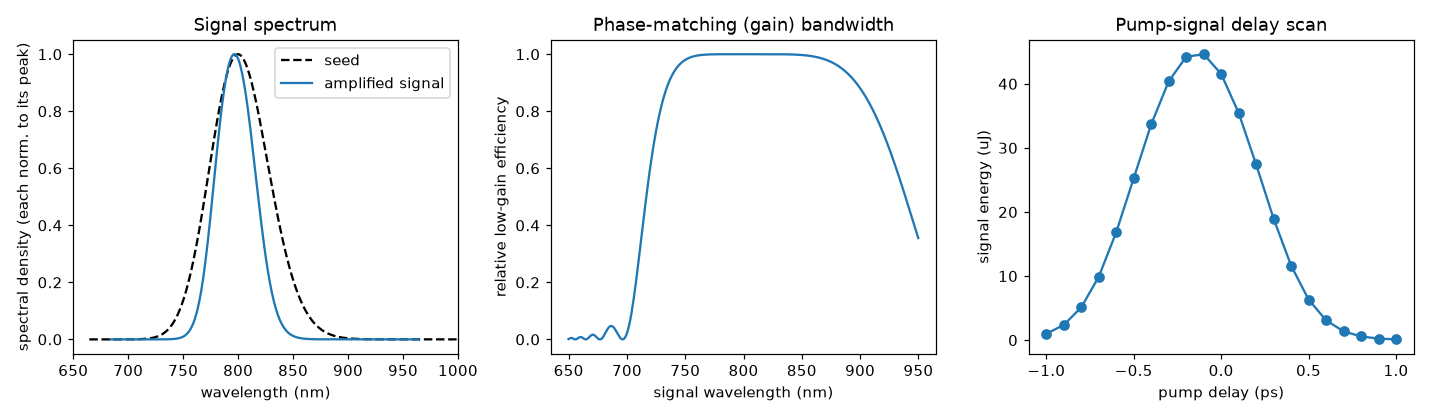
python plot.py draws this figure from results/. The 50 nJ seed leaves the crystal with 43.7 uJ (21 % of the
energy in, the rest is the idler and the unconverted pump). The middle panel shows why the non-collinear geometry
is used: the phase-matching curve is flat over a very wide band (FWHM 224 nm), far wider than the seed (15 fs
corresponds to roughly 60 nm). Even so, the amplified spectrum (left, solid) is narrower than the seed because the
gain is highest at the centre of the strongly saturated pulse; the compressed pulse is 23.8 fs, against 15 fs
for the seed. The delay scan (right) moves the pump across the 0.6 ps seed: the output energy is highest when the
pump is about 0.1 ps ahead of the signal's centre, which compensates the group-velocity mismatch between the beams
in the crystal, and it falls to near zero when the pump no longer overlaps the seed.
No example-08 results? Replace the aux "from" with a pulse:
"pulse": {"shape": "gaussian", "centerWavelengthM": 515e-9, "durationFwhmS": 0.8e-12, "energyJ": 200e-6}.
The 1-D model treats the beams through an overlap of Gaussian modes. For spatial gain narrowing,
walk-off and the pump's spatial depletion add "transverse": {"model": "radial"} (fast) or
{"model": "cartesian"} (needed for walk-off and the non-collinear geometry; slower) to the crystal.